
Ensuring medication safety for a senior with memory issues isn’t about better reminders; it’s about building a robust system that anticipates and prevents human error.
- Standard pillboxes often fail due to common dexterity and cognitive challenges.
- Automated dispensers and pharmacist-prepared blister packs significantly reduce the risk of dosage errors for complex regimens.
Recommendation: Create a Master Medication Administration Record (MAR) as the single source of truth and have it reviewed monthly with a pharmacist to ensure regimen integrity.
For any caregiver of a senior with memory issues, the fear of a missed or double-dosed medication is a constant source of stress. You’ve likely tried the standard advice: a seven-day pillbox, phone alarms, or sticky notes on the bathroom mirror. Yet, errors still happen. A forgotten dose can lead to a health crisis, while an accidental double dose can be just as dangerous. This cycle of worry and patchwork solutions is exhausting and, more importantly, not safe enough.
The common solutions fail because they rely on the senior’s compromised memory or the caregiver’s flawless attention, both of which are fallible. The truth is, managing a complex medication regimen requires more than simple reminders; it requires a system. It requires thinking like an engineer to identify potential points of failure and designing a process that makes the right action the easiest one. This is about creating a “fail-safe” environment that protects your loved one.
This guide moves beyond generic tips. As a geriatric pharmacist, I will walk you through building a multi-layered medication safety system. We will analyze why basic tools fail, compare advanced solutions designed for cognitive impairment, and establish processes that ensure accuracy and peace of mind. By the end, you will have a clear blueprint to transform medication management from a daily anxiety into a controlled, reliable routine.
To help you navigate these critical strategies, this article is structured to build your medication safety system step-by-step. The following summary outlines the key areas we will cover, from understanding the risks to implementing advanced solutions.
Summary: A System-Based Approach to Medication Safety
- Why “Forgotten Pills” Lead to 10% of Hospital Readmissions?
- How to Set Up a Fail-Safe Reminder System Without Complex Tech?
- Blister Packs vs. Automated Dispensers: Which Is Safer for Dementia?
- The Danger of Splitting Pills Without Pharmacist Approval
- How to Organize a Complex AM/PM Medication Schedule Effectively?
- Paper Tracking vs. Digital Apps: Which Is Better for Symptom Logging?
- Why Standard Pillboxes Fail Seniors With Dexterity Issues?
- Comparing Automated Pill Organizers for Complex Medication Regimens
Why “Forgotten Pills” Lead to 10% of Hospital Readmissions?
Medication non-adherence is not a minor issue; it’s a primary driver of severe health complications and costly hospitalizations among older adults. When a senior with memory issues forgets a critical dose of a blood pressure, diabetes, or heart medication, the consequences can be swift and serious. The problem is magnified in the vulnerable period following a hospital discharge, when medication schedules are often changed and confusion is high. This is where the system often breaks down completely.
The statistics are stark. While the title mentions 10%, some research indicates the problem may be even more severe in specific high-risk groups. For instance, a study on post-hospitalization vulnerability found that of 360 readmissions, an alarming 40% were medication-related, with seniors living alone being especially at risk. These events aren’t just statistics; they represent a fall, a stroke, or a cardiac event that could have potentially been prevented with a better medication management system.
The financial cost is significant, but the human cost is immeasurable. Each preventable hospitalization represents a decline in independence, an increase in caregiver burden, and a major setback to the senior’s quality of life. Understanding these high stakes is the first step toward appreciating that a simple pillbox is not a sufficient defense. We must build a system with the explicit goal of preventing these preventable adverse drug events and preserving health at home.
How to Set Up a Fail-Safe Reminder System Without Complex Tech?
Before investing in high-tech gadgets, the foundation of any medication safety system is a well-designed, low-tech environment. The goal is to use powerful environmental cues to make taking medication an automatic part of a daily routine, rather than an item on a to-do list that can be forgotten. This approach minimizes the cognitive load on the senior. A systematic review found that external reminders were the most frequently reported strategy and were associated with stronger adherence.
The core concept is creating a designated “Medication Station.” This isn’t just a place to store pills; it’s a visually organized, single-purpose area. Choose a high-traffic spot the senior uses at the same time every day, like the kitchen counter where they have breakfast or the nightstand beside their reading lamp. The key is to link the action of taking medication to an already established habit.
This station should be decluttered and highly visible. Use a simple tray to contain the pill organizer and any related items, like a dedicated water glass. For AM and PM doses, use clear visual distinctions. This can be as simple as placing the morning dose on the left side of the tray and the evening dose on the right. High-contrast labels (e.g., a bright yellow sun for morning, a dark blue moon for night) can be more effective than small-print text for those with visual impairments.
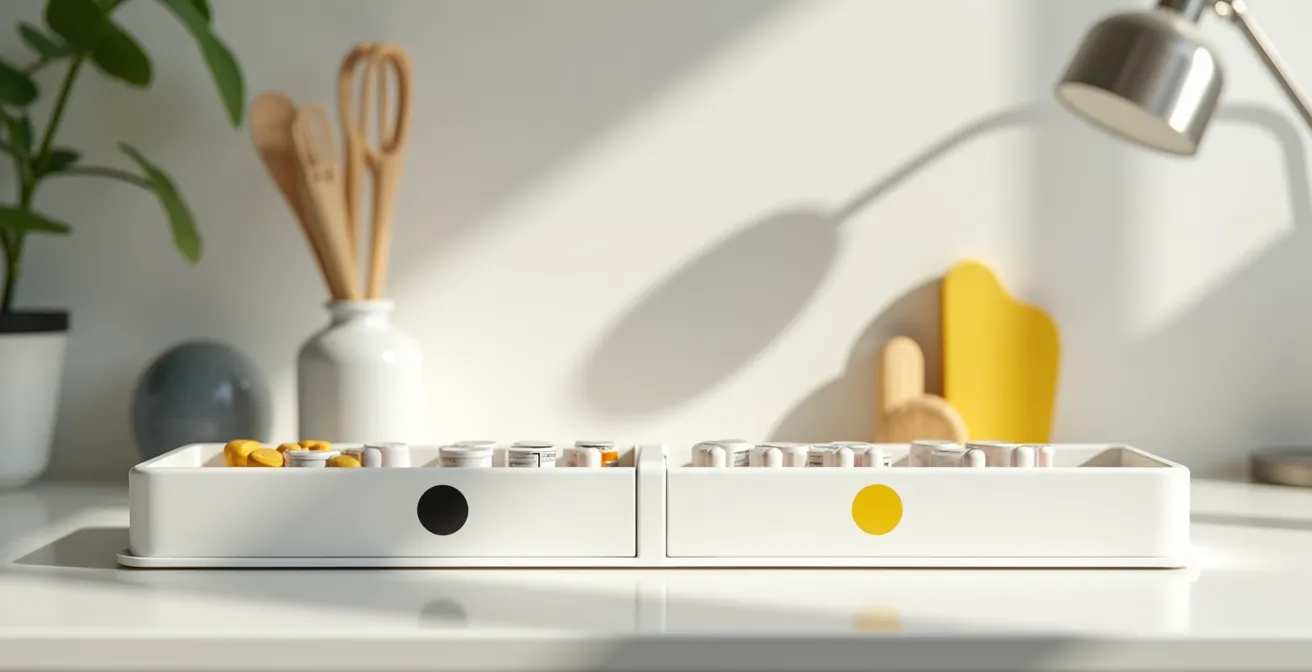
As this image illustrates, simplicity and clarity are paramount. The station is clean, with distinct zones and good lighting, making the task as straightforward as possible. This setup doesn’t rely on memory; it provides a physical, unmissable cue. The presence of the pill container in the “morning” spot serves as a trigger, and moving it to an “empty” spot after taking it provides immediate visual confirmation that the task is complete, reducing the risk of a double dose.
Blister Packs vs. Automated Dispensers: Which Is Safer for Dementia?
When a standard pillbox is no longer safe due to progressing cognitive decline, caregivers must choose between two primary upgrades: multi-dose blister packs prepared by a pharmacy or an automated pill dispenser. The right choice depends heavily on the senior’s specific stage of dementia and their cognitive abilities. Both options are significant improvements over self-filled organizers, but they address different failure modes.
Blister packs, also known as compliance packaging, are sealed cards where medications for specific times (e.g., “Monday Morning”) are packed together by a pharmacist. This eliminates the primary error of putting the wrong pills in the wrong slots. However, they still require the user to identify the correct day and time and to physically push the pills out. For someone with moderate dementia, this can still be confusing, and there’s nothing to stop them from popping out pills for future doses.
Automated pill dispensers are locked devices that only release the correct pills at the pre-programmed time, often with auditory and visual alerts. This dramatically reduces the cognitive load—the senior’s only task is to take the pills that have been dispensed. This is a far safer option for moderate-to-late dementia, as it prevents access to other doses and can alert caregivers remotely if a dose is missed. An expert review from the Tech-enhanced Life research team highlights this critical distinction:
The MedaCube has been designed specifically to be useful with impaired cognition, with specific features that help in this situation, while the Hero would not be a good choice for people with poor cognition, and the company specifically recommends against using it for dementia.
– Tech-enhanced Life Research Team, Automatic Pill Dispenser Evaluations
The following table, based on extensive research, helps compare these two solutions across key safety features for dementia care. It is a vital tool for making an informed decision with the healthcare team.
| Feature | Blister Packs | Automated Dispensers |
|---|---|---|
| Best For | Early-to-moderate dementia stages | Moderate-to-late dementia stages |
| Cognitive Load | Requires identifying correct day/time | Minimal – just take presented pills |
| Tamper Resistance | Low – can pop through multiple days | High – locked until scheduled time |
| Failure Mode | Human error (caregiver forgets) | Technical (power/connectivity loss) |
| Backup Plan Needed | Caregiver supervision | Battery backup, manual override |
The Danger of Splitting Pills Without Pharmacist Approval
In an effort to make pills easier to swallow or to adjust a dose, caregivers might be tempted to cut pills in half. This common practice is one of the most dangerous and underestimated risks in medication management. From a pharmacist’s perspective, this should never be done without explicit approval for that specific medication. Many pills are not designed to be split, and doing so can drastically alter how the drug works, turning a therapeutic dose into a toxic one.
The primary danger lies with medications that have a special coating, such as extended-release (ER/XR), sustained-release (SR), or enteric-coated formulations. These coatings are sophisticated delivery systems designed to release the medication slowly over many hours. Cutting the pill destroys this mechanism. The Cleveland Clinic warns that splitting extended-release pills can result in the entire dosage being released at once. This “dose dumping” can lead to a sudden, dangerous overdose of the medication, causing severe side effects or toxicity.
Even for pills that are “scorable” (have a line down the middle), achieving an accurate split is nearly impossible without a proper pill splitter. Using a knife creates uneven fragments and crumbles the pill, leading to inconsistent dosing. One half might contain 30% of the medication and the other 70%. For potent drugs with a narrow therapeutic window, this variation can be the difference between an effective treatment and a harmful one.

As this image vividly shows, a split pill is rarely a clean break. The crumbling and unevenness demonstrate the physical impossibility of ensuring equal halves. This visual evidence reinforces the core rule of medication safety: regimen integrity is paramount. If a dose needs to be adjusted, the prescriber must issue a new prescription for the correct strength. If swallowing is an issue, ask the pharmacist if a liquid or alternative formulation is available. Never compromise safety for convenience.
How to Organize a Complex AM/PM Medication Schedule Effectively?
For seniors on multiple medications—a situation known as polypharmacy—the complexity of the schedule itself is a major risk factor for errors. Research from Georgetown University’s School of Nursing notes that while 89% of adults age 65 and older take at least one prescription, 54% take four or more. Adherence drops significantly as the number of daily doses increases. Juggling medications that must be taken with food, on an empty stomach, or hours apart requires a robust organizational system.
The cornerstone of this system is the Master Medication Administration Record (MAR). This is not just a simple list; it is the single source of truth for every medication the senior is taking, including prescriptions, over-the-counter drugs, and supplements. It should be a formal document—digital or paper—that you bring to every single doctor’s appointment and pharmacy visit. This document ensures all providers are working from the same information, preventing dangerous drug interactions or duplicate therapies.
Organizing the MAR effectively involves more than just listing names and dosages. It requires a strategic approach to scheduling. Group medications by their specific requirements to simplify the daily routine. For example, create a “With Breakfast Group,” an “Empty Stomach Group” (taken 30-60 minutes before a meal), and a “Bedtime Group.” This batching process transforms a chaotic list of instructions into a clear, predictable workflow. The following plan outlines how to establish and maintain this vital system.
Your Action Plan: Creating a Master Medication Record (MAR)
- Create the Master Document: Build a comprehensive MAR listing every medication, dose, frequency, prescribing doctor, and purpose. This is your single source of truth.
- Group by Requirements: Organize the MAR not by name, but by administration rules. Create a ‘With Food Group,’ ‘Empty Stomach Group,’ and ‘Bedtime Group’ to streamline daily tasks.
- Schedule Monthly Reconciliation: Set a recurring monthly “brown bag” review. Gather all pill bottles and check them against the MAR for accuracy. Discard any old or discontinued medications.
- Synchronize Refill Dates: Work with the pharmacist to align all prescription refill dates to a single day each month. This simplifies pickups and reduces the chance of running out of a critical medication.
- Sequence Specific Drugs: For drugs that must be taken hours apart (e.g., thyroid medication and calcium supplements), clearly note the required time gap on the MAR to prevent interactions.
Paper Tracking vs. Digital Apps: Which Is Better for Symptom Logging?
Effective medication management goes beyond just administering pills; it also involves tracking symptoms, side effects, and vital signs to assess a drug’s effectiveness and safety. Both paper-based methods and digital applications can work for this, but the best choice depends on the caregiver’s comfort with technology and the complexity of the information being logged. The goal is to create a clear, consistent record that can be easily shared with healthcare providers.
A simple paper-based log—a notebook or a printed chart—is low-tech, reliable, and accessible to everyone. For many caregivers, this is the most straightforward method. A good log should have columns for the date, time, medication taken, any observed side effects (e.g., dizziness, nausea), and relevant vital signs (like blood pressure or blood sugar readings). The main advantage is its simplicity: there are no batteries to die, no software to update, and no learning curve. Its main disadvantage is that it can be cumbersome to share and analyze over time.
Digital applications, on the other hand, offer powerful features for tracking and analysis. Many apps not only log medication but also provide reminders, track adherence history, and allow for easy sharing of data with family members or doctors. Some even include features for logging mood, pain levels, and other symptoms on a graph, making it easier to spot trends. A study on digital health tools highlighted how a well-designed app with features like educational resources and social sharing can improve medication adherence in older adults by addressing key challenges.
Ultimately, the “better” method is the one you will use consistently. A hybrid approach can be very effective: maintain a simple paper log for daily entries, and then transfer the key data into a digital app once a week for long-term tracking and sharing. Whichever you choose, consistency is the key to creating a valuable record that helps the medical team optimize the senior’s care plan.
Why Standard Pillboxes Fail Seniors With Dexterity Issues?
The ubiquitous seven-day plastic pillbox is often the first tool a caregiver reaches for. While it seems like a simple solution, it has numerous design flaws that make it ineffective and even dangerous for seniors, particularly those with physical limitations that accompany aging. The issue of polypharmacy is a major factor; The Lown Institute reports that more than four in ten older adults take five or more prescription medications, making the task of just filling the box a high-risk activity for errors.
Beyond the initial filling, the daily use of a standard pillbox presents significant hurdles. Many of these organizers are designed with small, tight-fitting latches that require fine motor skills and grip strength. For a senior with arthritis, the simple act of applying point pressure to open a compartment can be painful and difficult. For someone with Parkinson’s, tremors can make the precise movements needed to open a single lid without spilling the contents of adjacent ones nearly impossible.
Other physical challenges create additional failure points. Neuropathy can cause numb fingertips that can’t feel the small latches or grip tiny pills. Common visual impairments like macular degeneration make it hard to read the tiny, low-contrast letters (S, M, T, W) on the lids. Furthermore, the compartments are often deep and narrow, making it difficult to retrieve small pills even after the lid is successfully opened. These are not minor inconveniences; they are fundamental design failures that create barriers to adherence.
The following points detail the specific failure modes of standard pillboxes based on common age-related health conditions:
- Arthritis: Applying pressure to small plastic latches causes significant pain in the finger joints, discouraging use.
- Parkinson’s Disease: Tremors make it difficult to open one compartment without spilling others, leading to “catastrophic spills” and lost doses.
- Neuropathy: Numb fingertips lack the tactile sensitivity to operate small latches or securely grip tiny pills.
- Visual Impairment: Small lettering and clear plastic lids with low contrast make it hard to distinguish days or times of day.
- Limited Dexterity: Even if a compartment is opened, scooping small pills out of deep, narrow wells is a significant challenge.
Key Takeaways
- Building a medication safety system requires moving beyond simple reminders to designing a process that anticipates and prevents errors.
- The foundation of this system is a Master Medication Administration Record (MAR) that serves as the single source of truth for all providers.
- Choosing the right tool—from low-tech labeled trays to high-tech automated dispensers—must be based on the senior’s specific cognitive and physical abilities.
Comparing Automated Pill Organizers for Complex Medication Regimens
When a medication regimen becomes too complex or a senior’s cognitive decline makes simpler systems unsafe, an automated pill organizer is the highest level of in-home medication safety. These devices are a significant investment, but they offer unparalleled security and peace of mind by taking human error almost entirely out of the daily dispensing process. They store, sort, and dispense medications at the correct time, and many can alert caregivers if a dose is missed.
These devices are not one-size-fits-all. They vary widely in capacity, features, and cost. Some, like the MedaCube, are designed specifically for patients with dementia, offering features like voice recordings from a loved one as a reminder and photo documentation of the pills being dispensed. Others, like Hero, are more app-driven and are better suited for tech-comfortable users and their caregivers. Dispensers like MedMinder offer robust remote monitoring capabilities, making them ideal when multiple family members are involved in care.
Choosing the right device requires a careful evaluation of the senior’s needs and the caregiver’s technical comfort. Key factors to consider include the number of unique medications, the need for remote monitoring, the importance of tamper resistance, and the monthly subscription costs, which can range from nothing to nearly $90 per month. The table below provides a comparison of leading models to help guide your research and discussion with your healthcare team.
| Dispenser | Capacity | Monthly Cost | Key Features | Best For |
|---|---|---|---|---|
| MedaCube | 90 days/16 meds | Device cost only | Voice recordings, 24hr battery backup, photo documentation | Dementia patients |
| Hero | 90 days/10 meds | $24.99-$39.99 | App integration, automatic sorting, alerts | Tech-comfortable users |
| MedMinder Maya | 28 days | $39.99-$89.99 | Remote monitoring, locked compartments, phone/text/email alerts | Multiple caregivers |
| MedReady | 28 days | $16+ cellular | Simple design, cellular alerts, manual key override | Basic needs, budget-conscious |
This investment in technology is often the final, critical layer of a comprehensive safety system. It provides a secure, reliable backstop that protects against the most common and dangerous medication errors. It automates the routine, freeing up the caregiver to focus on other aspects of care.
To implement these strategies effectively, begin by scheduling a medication review with their pharmacist. This consultation is the first step to building your Master Medication Record, simplifying the regimen where possible, and choosing the right tools for a truly fail-safe system.