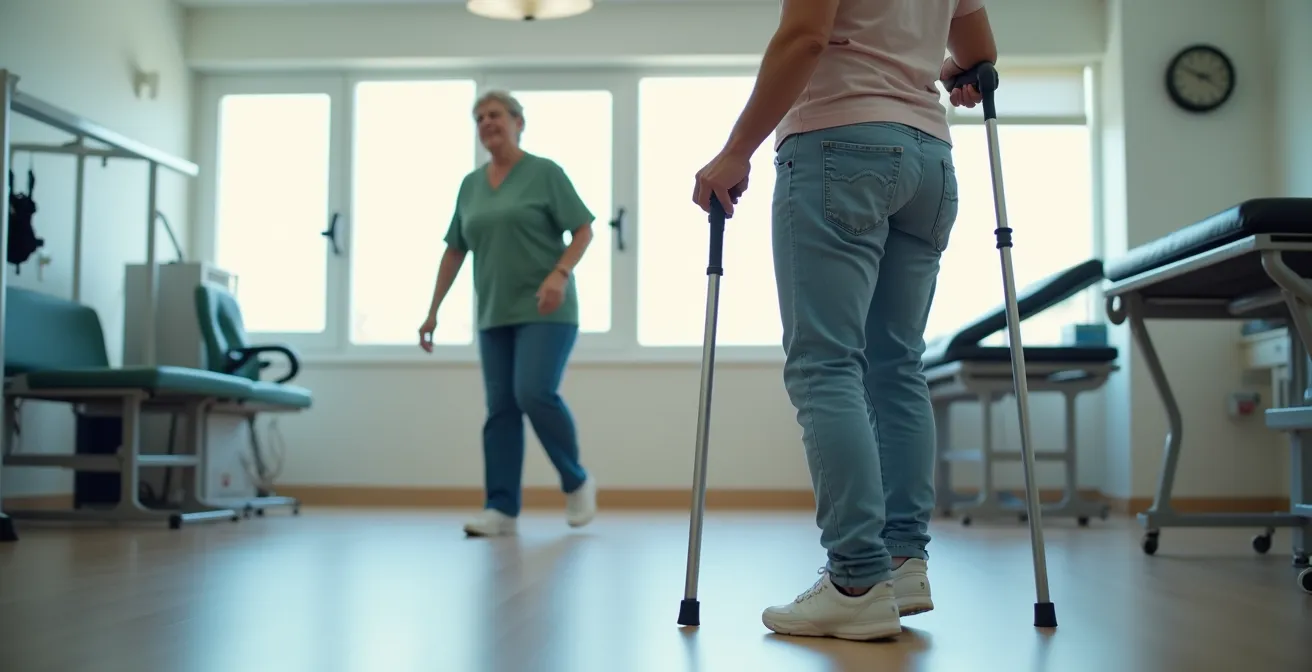
A quad cane is more than a walking aid; it’s a biomechanical tool that actively retrains your brain for stability after a stroke.
- It provides a significantly wider base of support to prevent dangerous lateral falls.
- Proper setup and technique are critical for safety, especially on stairs and varied floor surfaces.
Recommendation: Match the cane’s base size to your specific balance profile and practice daily integration for a successful and safe transition.
The journey to regaining mobility after a stroke is a unique and personal one. For many survivors, balance becomes a primary challenge, making every step feel uncertain. While a standard single-point cane offers some support, it often isn’t enough to address the significant lateral instability or weakness (hemiparesis) that can follow a stroke. The next step up, a walker, can feel cumbersome and restrictive, limiting true mobility.
This creates a critical gap in assistive technology. Many guides offer basic advice, but they often overlook the fundamental principles of why a particular device is effective. They might tell you what to do, but not why it works. The transition to a quad cane is not just about getting a cane with four feet; it’s a strategic decision in your rehabilitation. It is an intermediate step designed to provide a crucial balance of stability and freedom, empowering you to move with greater confidence.
This guide moves beyond simple instructions. As a neurological rehabilitation specialist, my goal is to explain the underlying biomechanics and neurological reasons that make a quad cane a powerful tool. We will explore the physics of stability, the cognitive skills needed for safe navigation, and how to correctly integrate this device into your daily life. Understanding these principles is the key to not just using a quad cane, but mastering it as part of your recovery.
For those who prefer a visual format, the following video offers a general demonstration of how to choose, measure, and use different types of canes. It can serve as a helpful visual complement to the specific quad cane techniques discussed in this guide.
This article is structured to guide you through the critical aspects of transitioning to a quad cane. From understanding its fundamental stability advantages to mastering complex situations like stairs and different floor types, each section builds upon the last to provide a comprehensive roadmap for your recovery.
Summary: Your Comprehensive Guide to Quad Cane Stability After a Stroke
- Why a Wide Base Quad Cane Prevents Lateral Falls?
- How to Climb Stairs Safely With a Large-Base Cane?
- Reversing the Handle: How to Set Up a Quad Cane for the Left Hand?
- The Risk of Catching the Quad Base on Carpets and Rugs
- Small Base vs. Large Base: Which Fits Your Balance Profile?
- Mastering Chronic Disease Management at Home for Complex Conditions
- Why Stepping Over the Tub Wall Is the #1 Fall Hazard in Bathrooms?
- Reducing Lower Limb Stress Through Biomechanical Adjustments
Why a Wide Base Quad Cane Prevents Lateral Falls?
A primary concern after a stroke is the risk of falling sideways, towards the weaker or affected side. A single-point cane offers minimal protection against this. The wide-base quad cane, however, is specifically engineered to counteract this vulnerability through fundamental biomechanical principles. Its key advantage lies in creating a dramatically larger Base of Support (BoS). This four-point “stability platform” on the floor is 3 to 4 times larger than that of a standard cane, creating a much bigger safe zone for your body’s weight.
This expanded BoS allows for greater management of your Center of Gravity (CoG). A fall occurs when your CoG shifts outside your BoS. With a wide-base quad cane, you can sway or move more laterally before your CoG reaches the tipping point. The cane’s base acts as a physical barrier, preventing you from falling toward your weaker side, a common issue in hemiparesis. This design is not just about passive support; it’s an active safety feature.
Furthermore, the four contact points enhance proprioceptive feedback—the sensory signals from the ground to your brain. This continuous stream of information about the floor’s texture and angle helps your brain make better, faster adjustments to maintain balance. This is so effective that research demonstrates the oxygen cost for quad canes was significantly lower for patients with poor balance compared to other cane types. This means your body works less hard to stay stable, reducing fatigue and making walking more efficient.
How to Climb Stairs Safely With a Large-Base Cane?
Navigating stairs is one of the most cognitively demanding tasks for any mobility aid user. It requires a combination of strength, balance, and careful sequencing. For quad cane users, the wide base that provides stability on flat ground can present a challenge on narrow steps. However, with the correct technique, it becomes a secure and reliable tool.
The experience of other stroke survivors highlights the importance of methodical practice. One 82-year-old survivor, in a report shared with the Mayo Clinic community, successfully navigated stairs just four months post-stroke. His success was built on the classic therapist-taught technique: “up with the good, down with the bad,” combined with turning the cane sideways to fit on the step. This illustrates that success is about adapting the tool to the environment, not forcing it.
To ensure safety, a clear, step-by-step protocol is essential. The following steps, adapted from clinical best practices, provide a reliable framework for mastering stairs:
- Assess the Step: If the stair tread is too narrow for the cane’s base, turn the quad cane sideways so the legs are parallel to the edge of the step.
- Cane First: Always move the cane onto the step first. Ensure all four feet are securely placed and stable before you move your body.
- Ascending (Going Up): After placing the cane, step up with your stronger leg first. Then, bring your weaker leg up to meet it on the same step.
- Descending (Going Down): Place the cane on the lower step first. Then, move your weaker leg down, followed by your stronger leg.
- Use Support: Always use the handrail if one is available. If not, stay close to a wall, using your free hand for touch support.
- Maintain a Rhythm: Never rush. Deliberate, conscious pacing is a critical safety feature that reduces the risk of missteps.
Reversing the Handle: How to Set Up a Quad Cane for the Left Hand?
A common but dangerous mistake when using a quad cane is incorrect orientation. Unlike a standard cane, a quad cane is not symmetrical. It has a specific “inward” and “outward” side, and setting it up improperly can create a serious trip hazard. The fundamental rule is simple, yet often overlooked.
As clinical guidelines from experts emphasize, proper orientation is non-negotiable for safety. In their reference guide for canes, the clinicians at Physiopedia provide a clear and direct rule:
When fitting a quad cane, be sure to orient it properly – the shorter legs are ALWAYS closer to the body to reduce tripping risk.
– Physiopedia Clinical Guidelines, Physiopedia Canes Reference Guide
This means the flat, straight side of the cane’s base must be flush against your body, whether you are using it on your left or right side. The legs of the cane should point away from you, not inward where your feet could catch on them. For most models, this requires reversing the handle. The offset grip is designed to center your weight over the base. If the handle is facing the wrong way, you may need to push a small button at the base of the handle, rotate it 180 degrees, and ensure it clicks securely back into place.
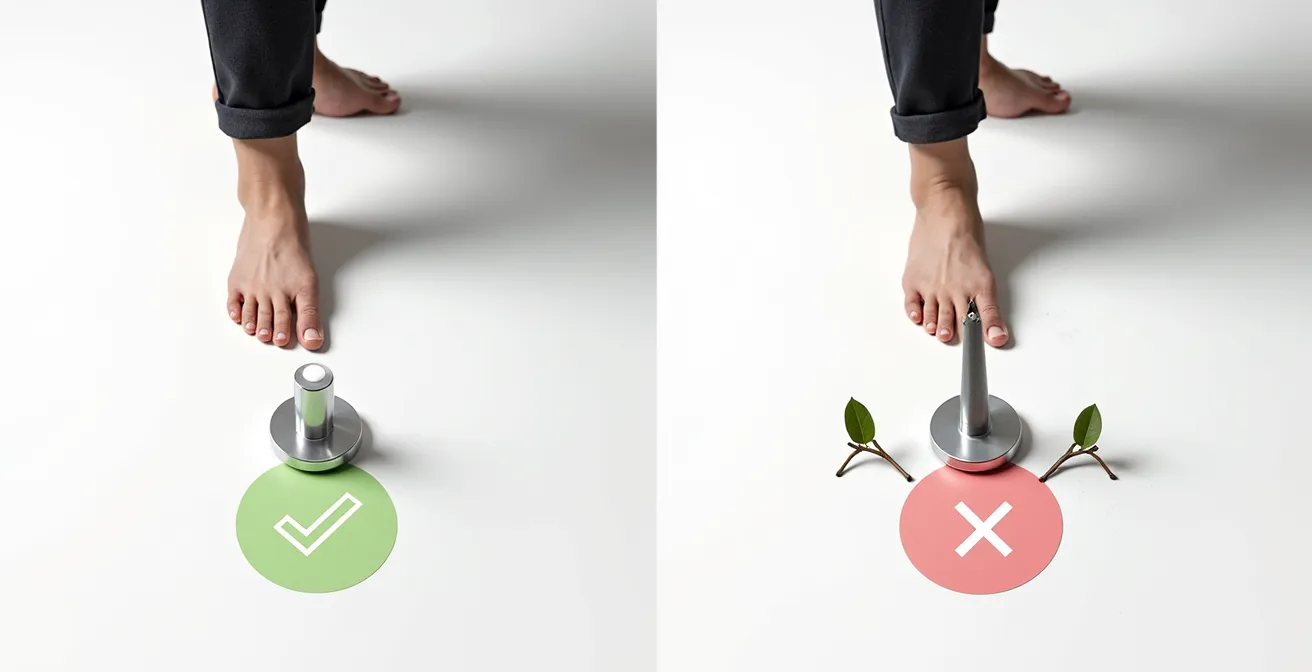
As you can see in the comparison, the correct setup on the left keeps the area around the foot clear, while the incorrect setup on the right introduces a direct obstacle. Verifying this orientation every time you use the cane is a vital safety habit that prevents the device itself from becoming a hazard.
The Risk of Catching the Quad Base on Carpets and Rugs
While the four-point base provides excellent stability, it also introduces a new risk: catching on uneven surfaces. Transitions between flooring types, like from hardwood to carpet, and the edges of throw rugs are high-risk zones for falls. Data from the CDC shows that stroke reduces mobility in more than half of stroke survivors age 65 and older, making fall prevention in the home environment paramount.
The issue arises because users tend to slide their cane rather than lift it. When a quad cane leg catches the edge of a carpet, it can abruptly stop the cane, causing a loss of balance and a potential forward fall. The solution is not to avoid these surfaces, but to develop a new motor skill: the “Lift-and-Place” technique. This requires consciously lifting the entire cane base off the ground and placing it firmly onto the new surface, rather than dragging it.
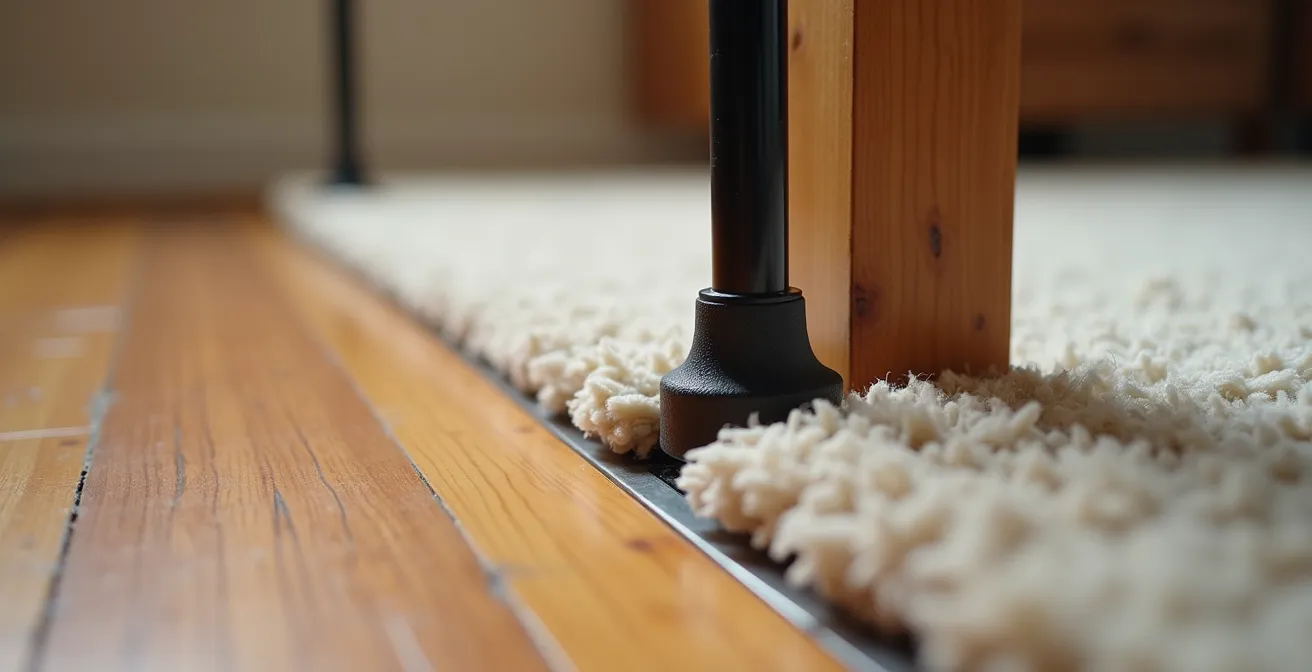
This technique is especially critical at thresholds between rooms. Practicing this deliberate lifting motion is a key part of your rehabilitation, turning a potential hazard into a manageable part of your environment. To systematically reduce these risks at home, it’s helpful to perform a hazard audit.
Your Action Plan: Surface Transition Hazard Management
- Identify High-Risk Zones: Map out all surface transitions in your home: hardwood to carpet, tile to rug, room thresholds, and even gaps at elevator doors.
- Practice the Lift-and-Place Technique: Consciously practice lifting the cane completely off the ground when moving between these identified surfaces.
- Secure Rugs: Secure all throw rug edges with double-sided carpet tape. Better yet, remove loose throw rugs entirely during your recovery period.
- Install Low-Profile Transitions: Use low-profile transition strips to create a smooth ramp between different flooring types, reducing the height of any “lip.”
- Scan Ahead: Especially for those with visual field cuts (hemianopsia), pause and scan the floor 6-8 feet ahead to anticipate upcoming surface changes.
Small Base vs. Large Base: Which Fits Your Balance Profile?
Quad canes are not a one-size-fits-all solution. They come in two primary configurations: large base and small base. Choosing the right one is a critical decision that should be based on your specific balance capabilities, your environment, and your rehabilitation goals. It’s a trade-off between maximum stability and maneuverability.
A large-base quad cane offers the widest possible Base of Support (BoS). This is the best choice for individuals with significant balance deficits, severe weakness on one side, or those in the very early stages of transitioning from a walker. Its larger footprint provides maximum confidence and protection against falls. However, its size can make it cumbersome in tight spaces and more challenging on narrow stairs.
A small-base quad cane provides a compromise. It offers substantially more stability than a single-point cane but is lighter and more nimble than its large-base counterpart. It is often ideal for users who have progressed in their recovery, have moderate balance issues, and need to navigate more confined spaces or community settings. The choice depends on a clinical assessment of your balance. A study on oxygen consumption in chronic stroke patients found that quad canes were most efficient for those with poorer balance (Berg Balance Scale scores below 49), while those with better balance were more efficient with single-point canes. This highlights the need to match the tool to the user’s capacity.
| Feature | Large-Base Quad Cane | Small-Base Quad Cane |
|---|---|---|
| Best For | Significant balance impairment; early recovery stages. | Moderate balance impairment; users needing more agility. |
| Stability | Maximum | Superior to single-point, less than large-base. |
| Maneuverability | Lower; can be cumbersome in tight spaces. | Higher; easier to use on stairs and in crowds. |
| Primary Goal | Maximizing safety and fall prevention at home. | Balancing stability with community mobility. |
Mastering Chronic Disease Management at Home for Complex Conditions
Successfully transitioning to a quad cane is about more than just learning to walk with it; it’s about integrating it seamlessly into the Activities of Daily Living (ADLs). This is a core component of managing a long-term condition like the after-effects of a stroke at home. The cane should become an extension of your body, a reliable partner in your daily routines, not an obstacle to be navigated around.
This integration requires conscious planning. At first, you will need to think deliberately about where the cane is and how you will use it for each task. For example, when preparing a meal, you can’t hold the cane and also chop vegetables. The solution is to position the cane securely against the counter, within arm’s reach, so it’s ready to provide support the moment you need to move.
Building a daily schedule for using the cane helps establish these new habits and reinforces safe practices. The goal is to make its use second nature, reducing the cognitive load required for mobility and freeing up mental energy for other tasks. A structured approach to daily use can look like this:
- Morning Routine: Keep the cane within arm’s reach of your bed. Use it for the initial transfer from bed to standing and for the walk to the bathroom.
- Kitchen Navigation: While preparing meals, position the cane against a counter. Use it for stability when reaching into upper or lower cabinets.
- Medication & Seated Activities: Keep the cane nearby while you are sitting. Use it to provide leverage and support every time you stand up.
- Bathroom Safety: Create a clear boundary. The quad cane’s rubber tips are not for wet surfaces. Park it outside the tub or shower and use installed grab bars for support inside the wet zone.
- Evening Practice: Dedicate 5-10 minutes each evening to practice walking in a safe, well-lit area of your home, focusing on a smooth gait and proper technique.
Why Stepping Over the Tub Wall Is the #1 Fall Hazard in Bathrooms?
The bathroom is statistically one of the most dangerous rooms in the house for falls, and the single greatest hazard is the act of stepping over the wall of a bathtub. This single movement combines several high-risk factors: it requires significant single-leg strength, dynamic balance, and navigating a high obstacle, often on a wet or slippery surface. For a stroke survivor, this is an exceptionally precarious maneuver.
A quad cane, while excellent for dry-land stability, is not the right tool for this specific task. Its rubber tips can slip on wet porcelain, and its wide base is too cumbersome to position safely within a tub. Physical therapy departments universally teach that the quad cane’s role must end at the edge of the tub. Forcing it into the wet zone is a recipe for disaster.
A case study on bathroom safety protocols demonstrates a clear solution. By implementing a structured transfer process where the quad cane is “parked” within reach outside the tub, falls were significantly reduced. The protocol relies on using the right tools for the job: a transfer bench and securely installed grab bars. The transfer bench creates a “bridge” over the tub wall, allowing a person to sit down outside the tub, swing their legs over, and slide into the bathing area without ever having to stand on one leg in a slippery environment. The grab bars provide secure handholds for adjusting position. This creates clear boundaries for assistive device use and is the clinical standard for bathroom safety.
Key Takeaways
- A quad cane’s primary advantage is its wide base of support, which is critical for preventing lateral falls common after a stroke.
- Safety on complex surfaces like stairs and carpets requires specific, learned techniques like the “Lift-and-Place” method, not just intuitive movement.
- Proper setup is non-negotiable: the flat side of the cane base must always be closest to your body to prevent creating a trip hazard.
Reducing Lower Limb Stress Through Biomechanical Adjustments
Beyond fall prevention, a primary function of any cane is to reduce the load on your lower limbs. After a stroke, the affected leg can be weak, painful, or have altered sensation. Using a quad cane correctly helps to offload a portion of your body weight from that leg, transferring it through your arm and the cane to the ground. This biomechanical offloading protects your joints, reduces pain, and can improve your walking pattern (gait).
The amount of weight you can offload is significant. While it varies by user, biomechanical studies suggest that a properly used cane should be able to support at least 25 percent of your body weight. To achieve this effectively and safely, the cane must be adjusted to the correct height. An incorrectly sized cane can cause new problems, such as shoulder, back, or wrist pain, and can compromise your posture and balance rather than improve it.
The standard clinical method for setting the correct height is as follows: stand up straight with your arms hanging relaxed at your sides. The top of the cane’s handle should be level with the crease of your wrist. When you grip the handle, your elbow should have a comfortable bend of about 20-30 degrees. This angle allows you to put pressure down through the cane without locking your elbow or hunching your shoulder.
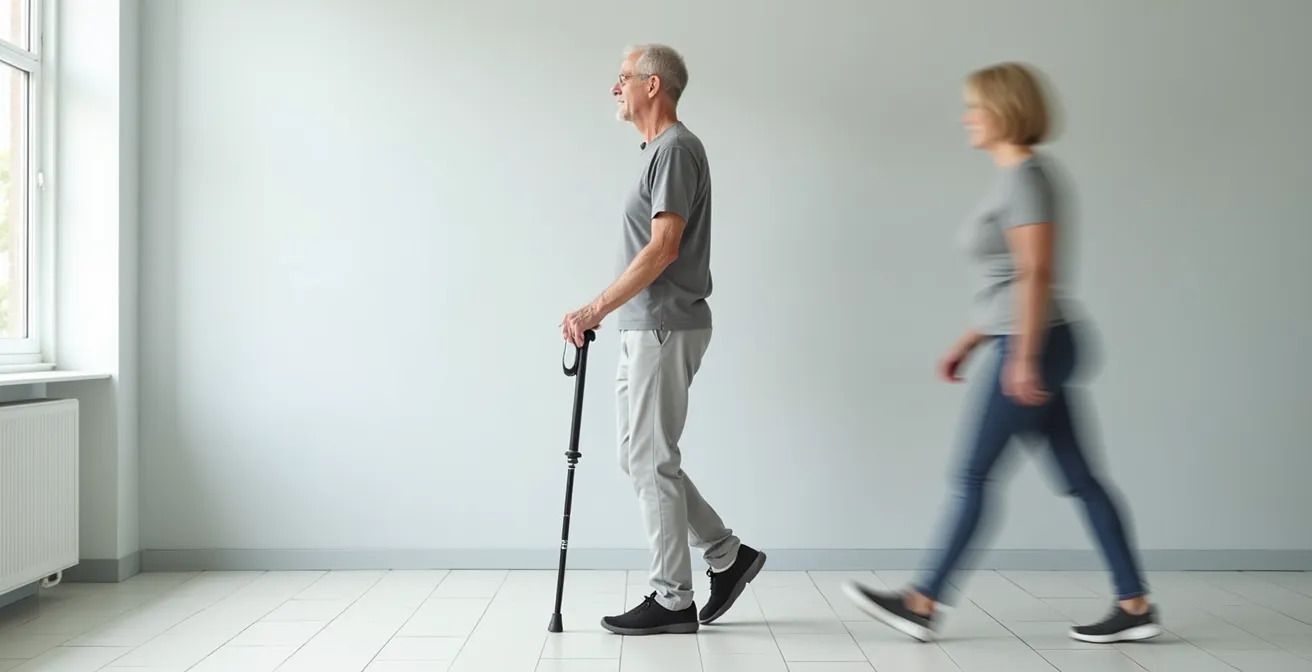
This correct alignment ensures that your spine remains neutral and your shoulders stay level while walking. It positions your body to use the cane as an effective tool for support, rather than forcing your body into an awkward position to accommodate the cane. Regularly checking this height adjustment is crucial, as it is the foundation of effective and safe use.
Embracing a quad cane is a significant step in your recovery, offering a pathway to greater independence and confidence. By understanding the principles behind its design and committing to the correct techniques, you transform it from a simple aid into a sophisticated rehabilitation tool. For personalized guidance and to ensure the cane is perfectly suited to your needs, the next logical step is to discuss these strategies with your physical or occupational therapist.