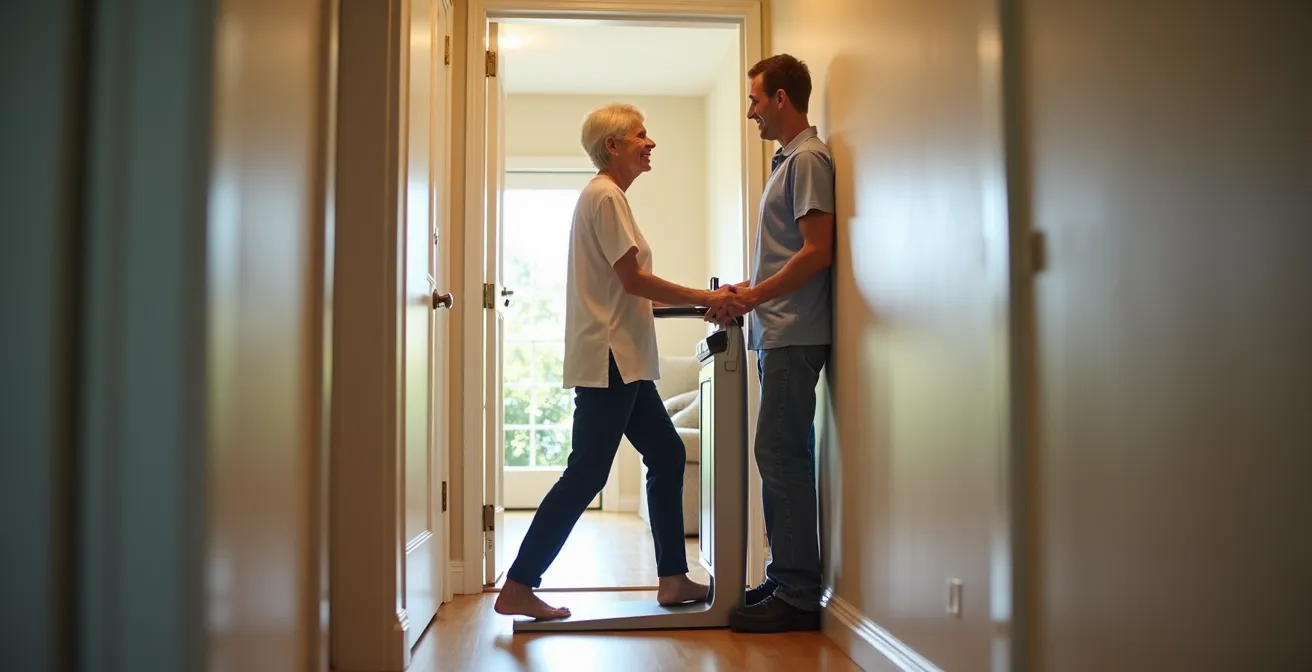
Selecting a patient lift for a spatially-challenged home is a technical assessment, not a shopping trip.
- The primary failure point is not the lift itself, but its incompatibility with your home’s clearance geometry, including doorway width, turning radii, and under-bed height.
- A lift’s Safe Working Load (SWL) must account for the patient’s current weight plus a 20% buffer for fluctuations, a detail often overlooked.
Recommendation: Before purchasing, conduct a full spatial audit of the primary transfer workflow, from bed to commode to chair, to identify the true minimum clearance requirements.
For caregivers in older homes, the daily task of transferring an immobile loved one is a constant battle against physics. Narrow doorways, tight corners, and cluttered rooms transform a simple move into a high-risk maneuver. The default solution, manual lifting, feels like a necessity, but it’s a ticking time bomb for a caregiver’s physical health. The market is filled with promises of electric lifts, but the common advice to “measure your doorways” is dangerously simplistic and often leads to costly purchasing errors.
The core issue isn’t just about finding a lift that fits through a door; it’s about understanding the entire transfer workflow as a spatial engineering problem. This requires a shift in perspective from simply buying a product to designing a safe, repeatable system. A lift that can’t navigate the turn from the hallway to the bathroom or slide under a low-profile bed is as useless as no lift at all. The key lies in analyzing the complete path, the equipment’s footprint when its base is splayed for stability, and the human factors involved in its operation.
This guide abandons generic advice. Instead, we will provide a durable medical equipment (DME) specialist’s framework for making a technically sound decision. We will dissect the biomechanical risks of manual lifting, compare hardware solutions from a spatial perspective, and establish non-negotiable safety protocols. By treating this choice with the seriousness of an engineering challenge, you can select a lift that not only prevents injury but truly integrates into your home and restores a measure of safety and dignity for both caregiver and patient.
To navigate this complex topic, this article is structured to walk you through every critical consideration, from the initial problem to the long-term benefits of a well-chosen system. Here is a summary of the key areas we will cover.
Summary: A DME Specialist’s Guide to Choosing a Patient Lift for Narrow Doorways
- Why Manual Lifting Ruins Caregiver Backs in 6 Months?
- How to Operate a Hoyer Lift Safely With One Person?
- Ceiling Tracks vs. Floor-Based Mobile Units: Which Fits Your Home?
- The Error of Buying a Lift That Isn’t Rated for the Patient’s Weight
- When to Introduce a Lift Before a Fall Occurs?
- Why Automated Lighting Prevents Nighttime Confusion in Dementia?
- Why a CNA Is Safer Than a Generic Caregiver for Patient Transfers?
- How to Adapt Cardio Exercises for Wheelchair Users Effectively?
Why Manual Lifting Ruins Caregiver Backs in 6 Months?
The physical toll of caregiving is not a vague possibility; it’s a statistical certainty for those who rely on manual lifting. The repetitive strain of moving an adult, often in awkward positions and tight spaces, creates a perfect storm for debilitating injury. The issue is rooted in fundamental biomechanics: the human body is not designed to function as a crane. Each lift puts immense compressive and shear forces on the lumbar spine, leading to micro-trauma that accumulates over time. Within months, this can escalate from soreness to chronic pain, herniated discs, and career-ending injuries.
The data on this is stark and unforgiving. According to one analysis, research indicates that over half of all caregivers sustain musculoskeletal injuries directly from lifting and transferring patients. This isn’t a sign of weakness; it’s the predictable outcome of performing a task that exceeds the body’s safe operational limits. The transition to a mechanical lift is therefore not a luxury or a convenience—it’s an essential piece of personal protective equipment for the caregiver.
Many families delay this crucial investment, sometimes due to the perceived cost or complexity. Financial constraints are real, as some insurance plans, like Medicare, have historically placed limitations on covering more user-friendly electric models versus manual hydraulic ones. However, the direct and indirect costs of a caregiver’s back injury—including medical bills, lost wages, and the potential need for outside help—far outweigh the initial investment in the correct equipment. Postponing the decision is simply deferring a predictable crisis.
How to Operate a Hoyer Lift Safely With One Person?
The question of single-person lift operation is one of the most common, and most critical, in home care. While many lifts are designed to be managed by one person, the real answer is nuanced and layered with warnings. As Lisa Cugasi, a registered nurse and nursing director at Comfort Keepers, starkly puts it:
No one should do it by themselves
– Lisa Cugasi, RN, Comfort Keepers nursing director interview
This statement isn’t a literal prohibition but a profound caution. It underscores that solo operation should only be attempted after extensive training, with a patient who is cooperative, and in an environment that has been fully optimized for safety. The risk is simply too high to “figure it out” on the fly. The key to safe solo operation is a meticulous, repeatable process, often called a “pre-flight checklist” in professional settings.
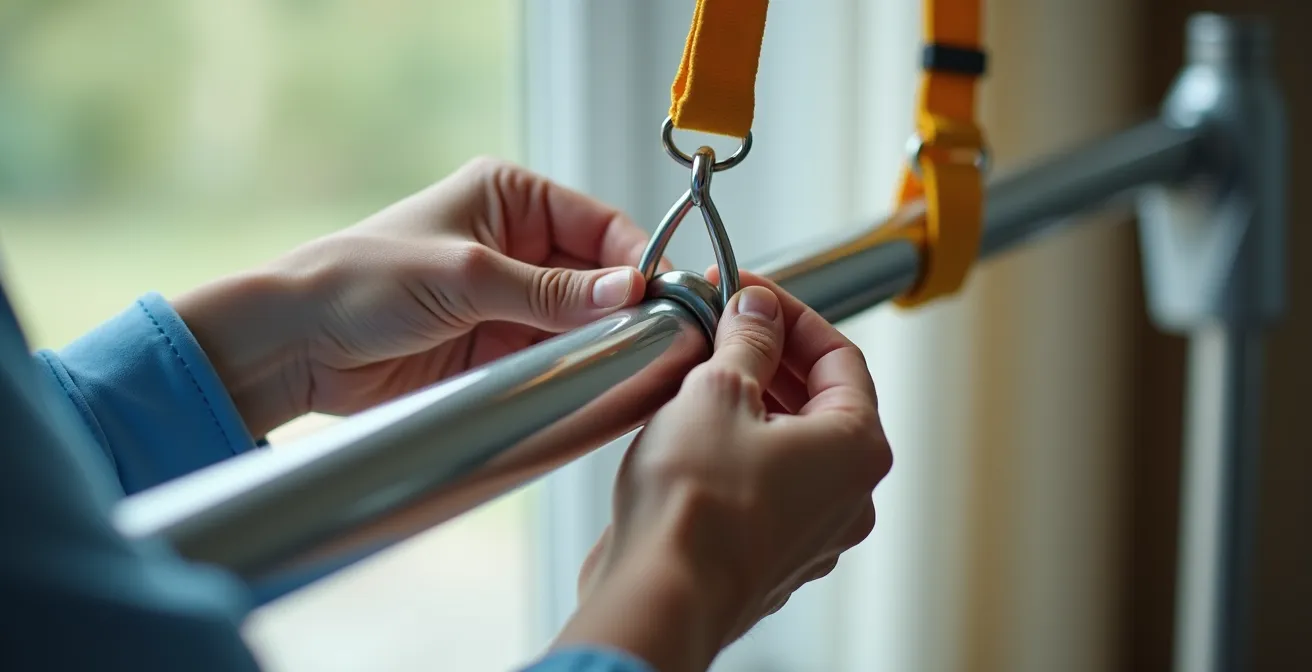
As seen in the detailed check above, every transfer must begin with a hands-on verification of the equipment. This includes checking that the sling is correctly positioned under the patient, all hooks and clips are securely fastened, and the path is completely clear of obstacles. One of the most vital steps, detailed in professional training protocols from organizations like PASCO, is the “dry-run” practice. This involves positioning the sling, rolling the patient, and securing everything *before* the lift begins. For solo operation, it is also paramount to keep the lift’s base at its maximum width to ensure stability throughout the transfer. Rushing this setup phase is the number one cause of preventable accidents.
Ceiling Tracks vs. Floor-Based Mobile Units: Which Fits Your Home?
The central dilemma in selecting a lift for a constrained space is choosing between a permanently installed ceiling track system and a portable floor-based mobile unit. This decision is less about which product is “better” and more about which system is compatible with your home’s unique architectural and financial reality. A floor lift offers flexibility to move between rooms but demands significant floor space, while a ceiling lift eliminates floor clutter but is confined to a fixed path and requires structural installation.
To make a sound decision, a direct comparison of their spatial and financial requirements is essential. A comprehensive analysis from MDA’s Quest Magazine highlights the critical trade-offs, which are vital for anyone facing this choice. The following data is adapted from their breakdown of ceiling versus floor lifts.
| Feature | Ceiling Track Lifts | Floor Mobile Units |
|---|---|---|
| Space Requirements | No floor footprint, ideal for tight spaces | Requires 4-6 feet clearance, difficult in narrow hallways |
| Installation Cost | $3,000-$8,000 with structural assessment | $1,000-$4,000 ready to use |
| Maneuverability | Limited to track path | Can transfer between any rooms |
| Floor Clearance Needed | None – overhead system | Several inches under bed required |
| Storage When Not in Use | Motor stays on ceiling | Requires dedicated storage space |
| Power Options | Hard-wired or battery | Manual hydraulic or battery electric |
For older homes with doorways often measuring less than 30 inches, the 4-6 feet of clearance required for a mobile unit’s base to splay and turn can be an immediate disqualifier. A ceiling lift bypasses this issue entirely, making it the superior technical solution for extremely tight spaces like small bathrooms. However, the significantly higher installation cost and the need for a professional structural assessment of your home’s ceiling joists can be a major barrier. The choice ultimately requires balancing the ideal spatial solution with your practical budget and the structural integrity of your home.
The Error of Buying a Lift That Isn’t Rated for the Patient’s Weight
Among the most hazardous mistakes in selecting a patient lift is misunderstanding or ignoring its weight capacity. This isn’t just about matching the number on the box to the patient’s weight on a scale; it’s a critical safety calculation that requires a specialist’s mindset. The FDA has issued specific safety guidelines on this topic, stating unequivocally that you must ” ensure patient’s weight does not exceed the limits” of both the lift and the sling. A failure at this point is catastrophic.

The most important concept to understand is the Safe Working Load (SWL). This is a certified rating that represents the maximum load the lift can handle safely, and it is often different from a marketing term like “maximum capacity.” A professional approach involves calculating the total lift load, which includes not just the patient but also the sling and any attached medical devices. Furthermore, a crucial safety buffer must be applied. Patient weight fluctuates, and planning for a 20% safety margin above their current weight accounts for these changes and ensures long-term safety. It is also vital to verify the weight limit of the sling itself, as it can sometimes be lower than that of the lift.
To prevent this critical error, a systematic verification process is not optional; it’s mandatory. The following checklist formalizes the steps required to confirm your equipment is appropriately rated for your specific situation.
Action Plan: Safe Working Load Verification
- Calculate total lift load: Patient weight + sling weight + attached medical devices.
- Apply a 20% safety buffer to the current patient weight to account for future fluctuations.
- Verify the lift’s official Safe Working Load (SWL) certification, not just the marketing “maximum capacity.”
- Check the sling’s weight limit separately, as it may be lower than the lift’s capacity.
- Document weight assessments regularly to track any changes over time and ensure continued compliance.
When to Introduce a Lift Before a Fall Occurs?
The decision to introduce a patient lift is too often made reactively, *after* a fall has occurred or a caregiver has been injured. A proactive approach, guided by an occupational therapist (OT), is fundamentally safer. The right time to introduce a lift is at the first sign of transfer instability, long before a crisis. These warning signs are clear: a caregiver’s hesitation before a transfer, the patient grabbing onto furniture for support, an increase in “near misses,” or a caregiver experiencing new or worsening back pain.
For patients with progressive conditions like Multiple Sclerosis (MS) or Parkinson’s, this proactive planning is even more critical. An OT evaluation can establish a timeline for equipment needs. For example, a patient may initially be able to use a sit-to-stand lift, which requires them to have some trunk control and weight-bearing ability. This is an excellent intermediate step. However, as the condition progresses and trunk control weakens, a full-body sling lift will become necessary.
Introducing the equipment in stages serves a vital psychological purpose. A case study on transfer planning for progressive diseases shows that introducing a sit-to-stand lift early helps the patient become accustomed to and accept mechanical assistance. This gradual acclimatization makes the eventual transition to a full sling lift less traumatic and emotionally charged. It reframes the equipment not as a symbol of decline, but as a tool for maintaining safety and prolonging the ability to age in place. Waiting until the patient is completely dependent creates a much higher barrier to acceptance.
Why Automated Lighting Prevents Nighttime Confusion in Dementia?
For patients with dementia, nighttime can be a period of heightened confusion and disorientation, a phenomenon known as sundowning. A simple trip to the bathroom becomes a high-risk event, especially when a patient lift is involved. Dim lighting can distort perception, obscure obstacles, and increase the likelihood of a fall during a transfer. According to FDA safety data, falls from lifts are particularly dangerous, potentially causing severe head trauma, fractures, or even death. Therefore, engineering a safe nighttime environment is a critical component of any home care plan.
Automated lighting is a powerful and effective solution. It moves beyond a simple nightlight to create a guided, intelligent environment. The goal is to illuminate the path without causing startling brightness that can worsen confusion. This is achieved by using motion-activated LED strips, particularly those with a warm color temperature (around 2700K), which is less jarring to the circadian rhythm. These lights should be installed along the floor, tracing the exact route the patient lift will take from the bedside to the bathroom.
A truly effective setup involves a multi-layered approach to illumination. The system should include:
- Motion-activated LED strips to define the primary transfer path on the floor.
- Dedicated spot lighting at critical transfer points, such as beside the bed and over the commode area, to ensure clear visibility for the caregiver.
- A dawn-simulating light programmed to gradually brighten the room in the morning, preparing the patient for their first transfer of the day in a gentle, non-disruptive way.
This “light-guided” route provides just enough illumination for safety while minimizing cognitive disruption. It transforms the nighttime environment from a source of anxiety into a predictable, safe space, significantly reducing the risk of falls and distress for patients with dementia.
Why a CNA Is Safer Than a Generic Caregiver for Patient Transfers?
Operating a patient lift may seem as simple as pushing a button, but the difference between a safe transfer and a dangerous one lies in technique, training, and experience. While any compassionate person can be a caregiver, a Certified Nursing Assistant (CNA) brings a level of professional training that is invaluable, especially in complex transfer situations. The difference is not in their ability to operate the machine, but in their understanding of body mechanics, patient positioning, and risk assessment.
Professional training centers, like those for spinal cord injury rehabilitation, often train family members alongside CNAs. These sessions reveal the immense value of professional oversight. A CNA can correct subtle but critical errors in sling placement, body alignment during the lift, and maneuvering techniques that a family member might never notice. This hands-on, corrected practice builds the confidence and muscle memory required for consistent safety. It’s not “rocket science,” but it is a skilled procedure where small details have major consequences.
The professional standard itself is built on a foundation of safety that starkly contrasts with the risks of manual lifting. According to OSHA, occupational safety standards specify that healthcare workers shouldn’t lift more than 35 pounds manually on a regular basis. This single guideline underscores why the entire professional healthcare system has moved to mechanical lifts. A CNA is trained within this safety-first culture, viewing the lift not as an option but as a mandatory tool for adhering to professional standards of care and preventing injury to both themselves and the patient.
Key Takeaways
- Choosing a patient lift is a spatial engineering task focused on clearances and turning radius, not just doorway width.
- Always verify the certified Safe Working Load (SWL) and add a 20% buffer to the patient’s weight; check sling capacity separately.
- Introducing a lift proactively at the first sign of instability is safer and aids patient acceptance, especially with progressive conditions.
How to Adapt Cardio Exercises for Wheelchair Users Effectively?
The conversation around patient lifts often centers on safety and necessity, but their true value lies in what they enable. A properly used lift is a gateway to a fuller, more active life. As BAYADA’s Cay Ambrose states, “If used properly, mechanical lifts can allow for more independence.” This independence extends beyond basic transfers to activities that promote wellness and health, such as adapted exercise. For wheelchair users, conserving energy during transfers is key to having enough stamina left for a workout.
A patient lift can be integrated directly into an exercise routine, acting as a critical tool for energy management. Instead of the caregiver and patient expending significant energy on a manual transfer just to get into position, the lift does the heavy work. This preserves the patient’s strength for the actual cardio activity, whether it’s using an arm ergometer, resistance bands, or other adapted equipment. It also protects the caregiver from fatigue-related injuries post-workout.
A sample transfer protocol shows how seamlessly a lift can be integrated into a wellness plan, transforming the prospect of exercise from a daunting task to an achievable goal:
- Step 1: Morning Transfer: Use the Hoyer lift for the initial bed-to-wheelchair transfer, conserving both patient and caregiver energy for the day.
- Step 2: Positioning for Exercise: Position the wheelchair next to the adapted exercise equipment.
- Step 3: Pre-Cardio Warm-Up: If applicable, use a sit-to-stand lift for a few weight-bearing repetitions to warm up muscles.
- Step 4: Cardio Routine: Complete the wheelchair cardio workout, with the caregiver now available to assist with the exercise itself, not exhausted from the transfer.
- Step 5: Return Transfer: Use the lift for the return transfer, preventing injury when both parties are fatigued from the workout.
This protocol reframes the patient lift from a simple utility for daily needs into an empowering tool for health and well-being. It is the final piece of the puzzle, demonstrating that the right equipment, chosen with care and technical precision, doesn’t just make life safer—it makes it better.
To ensure the safest and most effective transfer system for your unique home environment, the next logical step is to seek a professional assessment from an occupational therapist or a qualified DME specialist.
Frequently Asked Questions about Choosing a Patient Lift
What are the key warning signs that indicate it’s time for a patient lift?
Caregiver hesitation before transfers, patient grabbing furniture for stability, increased ‘near misses’, or caregiver experiencing back pain after transfers all signal the need for mechanical assistance.
How can I convince a resistant loved one to accept using a lift?
Frame it as gaining freedom rather than giving in – emphasize how the lift enables more activities, reduces pain for everyone, and actually prolongs safe aging in place.
Are trial periods available before purchasing expensive lift equipment?
Many medical supply companies offer rental programs or 30-day trials, often recommended by occupational therapists, allowing families to test equipment without large upfront commitments.