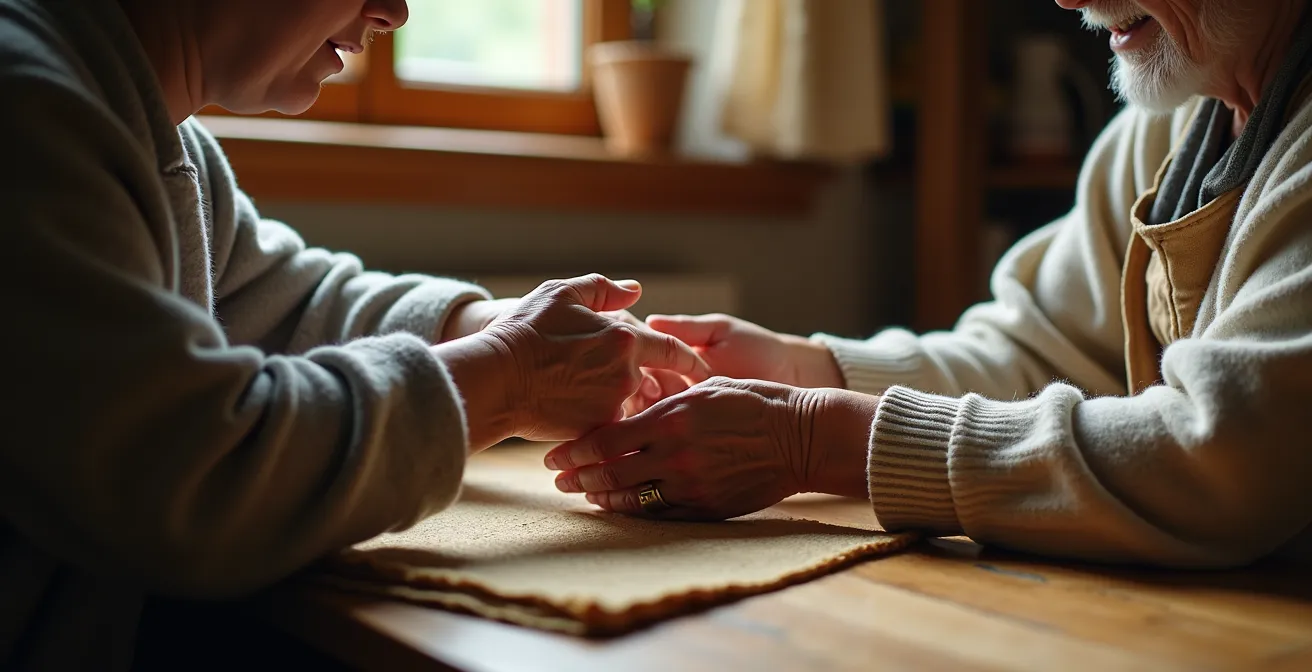
True fulfillment in later life isn’t about staying busy; it’s about building a living legacy through meaningful connection.
- Shifting your mindset from ‘aging’ to ‘wisdom transference’ transforms physical limitations into opportunities for deeper bonds.
- Practical tools like memoir writing, digital groups, and daily gratitude rituals are not hobbies, but powerful acts of narrative curation.
Recommendation: Begin by reframing one daily interaction not as a conversation, but as a chance to share a piece of your unique story.
We are often told that the key to a good later life is to “stay active” and “stay healthy.” This advice, while well-intentioned, often misses a fundamental human need that grows more potent with time: the need for purpose. A schedule filled with activities can still feel empty if it lacks a sense of meaning. We fill our days, but do we fill our souls? The pursuit of physical well-being is vital, but it is only one half of a deeper equation.
The common solutions—volunteering, joining clubs—are presented as cures for loneliness, but they can feel like putting a bandage on a wound that requires deeper healing. What if the profound loneliness some feel isn’t just an absence of people, but an absence of being truly seen and valued for the immense library of experience one holds within? The true challenge isn’t just to connect, but to connect in a way that feels consequential.
But what if the key wasn’t simply to find things to do, but to cultivate a state of Harmonious Well-Being? This is a perspective where the focus shifts from warding off decline to actively curating one’s legacy. This article proposes a different path: that intergenerational connection is not a passive pastime, but the active, philosophical work of transforming your life’s wisdom into a living gift for others. It’s about reframing your role from one of conclusion to one of essential, vibrant continuation. We will explore the profound ‘why’ behind this approach before diving into the practical ‘how’ of building these bridges of meaning.
This guide will walk you through a series of philosophical shifts and practical actions. We will explore the deep-seated reasons why purpose is so vital, and then provide tangible methods to cultivate it, regardless of physical circumstance.
Summary: The Art of Weaving Your Legacy Through Connection
- Why Purpose Reduces Mortality Rates in Over-75s?
- How to Start a Memoir Project to Document Life Legacy?
- Mindfulness Practices Adapted for Seniors With Focus Issues
- The Mistake of Letting Physical Limitations Dictate Emotional State
- How to Find Purpose-Driven Activities With Limited Mobility?
- How to Break Negative Thought Loops About Aging and Uselessness?
- How to Create a Daily Ritual for Gratitude and Reflection?
- How to Encourage Participation in Digital Social Groups?
Why Purpose Reduces Mortality Rates in Over-75s?
The connection between a sense of purpose and a longer, healthier life is more than just a comforting thought; it’s a well-documented psychological and physiological reality. When we have a reason to get up in the morning that extends beyond ourselves—a project to nurture, a person to guide, a story to tell—our entire being responds. This is the essence of Harmonious Well-Being: a state where our mental, emotional, and physical health align around a central, meaningful core.
A strong sense of purpose acts as a powerful buffer against stress. It reframes challenges as obstacles to be overcome in service of a greater goal, rather than as personal failings. This mindset has a direct impact on the body, helping to regulate stress hormones like cortisol, which, when chronically elevated, can contribute to a host of health issues. Having a purpose encourages future-oriented thinking, creating a positive feedback loop that promotes healthy behaviors, from better sleep to more consistent self-care.
More profoundly, purpose is about narrative. When you feel your life’s story is still being written, and that you are the author, you are less likely to feel like a passive observer of your own decline. Intergenerational connection is a powerful source of this narrative fuel. The act of teaching a grandchild, sharing wisdom with a younger friend, or simply being a repository of history for those who will come after, gives your story a vital, ongoing role. It confirms that your life is not just a collection of memories, but a living, breathing resource. This feeling of being needed and valued is perhaps the most powerful medicine of all.
How to Start a Memoir Project to Document Life Legacy?
If purpose is the ‘why’, then a memoir is one of the most powerful ‘hows’. It is the ultimate act of Narrative Curation, a conscious decision to shape your life’s experiences into a tangible legacy. It is far more than a simple recounting of events; it is a declaration that your story matters, that the lessons you’ve learned have value, and that you have something profound to offer future generations. As The Memoir Network beautifully articulates in their guide, “Seniors Writing Memoirs and Lifestories”:
Seniors have the benefit of experience—years of it. Experience backed by reflection is the stuff of memoir. If a function of memoir is to shed light on the meaning of life, then seniors are in an excellent position to shed light on the meaning of life for younger readers
– The Memoir Network, Seniors Writing Memoirs and Lifestories
The process itself is a journey of rediscovery. It transforms you from a passive holder of memories into an active historian of your own soul. The fear of “where do I even begin?” is common, but it can be overcome by breaking the monumental task into a series of small, meaningful steps. This is not about writing a bestseller; it is about creating a priceless heirloom.
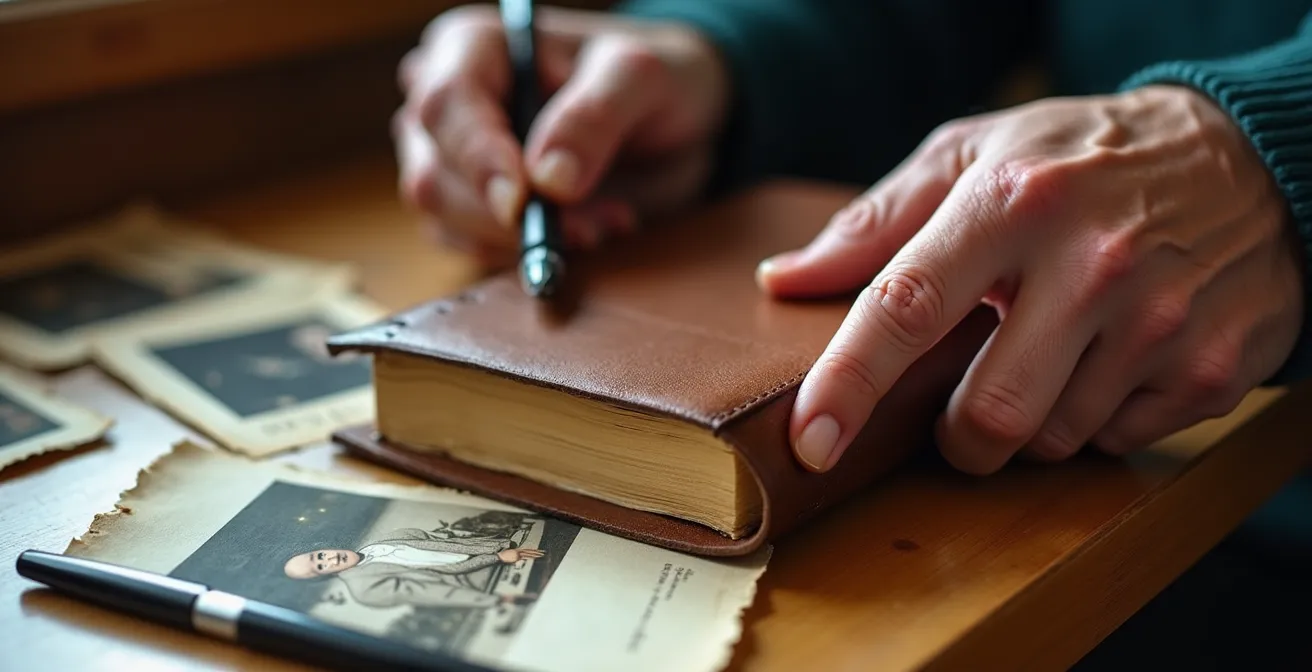
Beginning your memoir journey is an act of profound self-worth. It is a gift not only to your descendants but to yourself—a chance to see the full, beautiful tapestry of your life laid out before you. Here are some essential steps to guide you:
- Research and Read: Before you write, read a few memoirs to understand their structure. This isn’t about copying, but about learning the language of life stories.
- Find Your Community: Join a life story or memoir writing group. If one doesn’t exist at your local senior center or library, be the catalyst and see if you can start one.
- Place Yourself in History: Your personal story is woven into the larger story of the world. Write about where you were during major historical events and how your family experienced them.
- Write Your ‘Ethical Will’: What are the core values, life philosophies, and mottos you want to pass on? This document can become the heart of your memoir.
- Show, Don’t Tell: Instead of saying you were happy, describe the scene that made you happy. Paint a picture with words, focusing on sensory details.
- Enlist Help: Don’t let technology be a barrier. Ask a family member with computer skills to help you compile, format, and even self-publish your collection of stories.
Mindfulness Practices Adapted for Seniors With Focus Issues
To engage in the deep work of legacy building, one needs a certain degree of mental clarity. Yet, the mind can often be a noisy place, filled with worries about the future, regrets about the past, or simply a distracting inner monologue. For many seniors, especially those facing new challenges with sustained focus, this internal chatter can be a significant barrier to feeling present and purposeful. This is where mindfulness offers a gentle yet powerful tool.
Mindfulness is not about emptying the mind, which is an impossible task. It is the practice of paying attention to the present moment without judgment. For a senior struggling with focus, this doesn’t have to mean sitting in silent meditation for an hour. It can start with something as simple as mindfully drinking a cup of tea: noticing its warmth, its aroma, its taste. These small “anchors” to the present can be a profound relief from the whirlwind of thought.
The benefits are not merely anecdotal. The practice of Mindfulness-Based Cognitive Therapy (MBCT) has been shown to be highly effective. A study published in the US National Library of Medicine on the effects of MBCT for older adults found significant improvements in anxiety, rumination, and sleep quality among participants. By learning to observe their thoughts as passing clouds rather than identifying with them, participants gained a crucial sense of emotional freedom. This practice of Emotional Alchemy—turning the lead of anxious thought into the gold of present-moment awareness—is a skill that directly supports the cultivation of a purposeful life by clearing the space for gratitude and connection to grow.
The Mistake of Letting Physical Limitations Dictate Emotional State
One of the greatest fallacies of aging is the belief that our physical capacity must define our emotional horizon. As mobility decreases or health challenges arise, it’s easy to feel that our world is shrinking. But this is a mistake of perspective. Our emotional and spiritual worlds are boundless, and it is within our power to ensure they remain expansive, vibrant, and full of purpose, even when the body presents limitations.
This is not about ignoring physical reality, but about refusing to let it become the sole narrator of our experience. It is about the radical act of choosing joy, purpose, and connection in defiance of constraint. This requires a conscious shift in mindset, from focusing on what is lost to celebrating what remains and what can still be given. The most potent catalyst for this shift is intergenerational connection, which reminds us that our value lies not in our physical abilities, but in our wisdom, our stories, and our capacity for love.
This principle is brought to life in remarkable ways every day. Consider the following powerful examples drawn from a PBS feature on “Rethinking Aging”:
Case Study: The Benevilla Community Center
In Arizona’s West Valley, the Benevilla Community Center for older adults, many of whom are in the early stages of dementia, made a revolutionary choice: they integrated an on-site preschool. As detailed in the PBS exploration of innovative aging programs, activities with “Benevilla’s grandmas and grandpas” are now a core part of the children’s curriculum. The seniors are not patients being cared for; they are mentors, storytellers, and friends, actively contributing to the development of a younger generation. Their purpose is renewed daily.
This kind of environment fosters a beautiful symbiosis, as articulated by a participant in a similar village model:
‘There are younger members of the village, which is great, and there are older members, and together that’s the melding that really takes place. And it’s good for younger kids to interact with older people, to see that, well, these aren’t just stuffy old people waiting for their wheelchair.’
– Fred O’Regan
These examples illuminate a profound truth: when we are engaged in the act of giving, our own limitations seem to fade into the background. Our spirit is called to a higher purpose, and in answering that call, we find a wellspring of vitality that no physical ailment can diminish.
How to Find Purpose-Driven Activities With Limited Mobility?
The reality of limited mobility can feel like a closing door, cutting off access to the activities and communities that once brought joy and purpose. Volunteering, joining clubs, or visiting family can become logistical challenges. However, in our increasingly connected world, physical presence is no longer the only way to make a meaningful impact. Technology, when wielded with intention, can open up a universe of possibilities for Wisdom Transference.
The key is to shift the search from “activities I can physically do” to “ways I can share my unique value.” Your decades of experience, your perspective on life, your skills, and your stories are invaluable assets that are not bound by physical location. Mentoring a young professional, helping a student with a history project, or simply offering a listening ear to someone in need are all profoundly purposeful acts that can be done from the comfort of your own home.
This is not a futuristic fantasy; it’s a present-day reality for thousands of seniors who have discovered the power of digital connection. They are proving that a rich, purposeful life is not contingent on one’s ability to travel, but on one’s willingness to reach out.
Case Study: The Big & Mini Project
A prime example of this new frontier of connection is The Big & Mini Project. As highlighted in a MedCity News report on intergenerational health, this initiative pairs older adults (“Bigs”) with young people (“Minis”) for regular video calls. It goes beyond simple conversation, fostering genuine friendships that combat loneliness and dramatically improve mental well-being for both generations. Participants are not just passing time; they are building relationships, sharing life lessons, and creating a sense of community that transcends geographical and physical barriers.
Projects like this demonstrate a fundamental truth: the desire for connection is universal. By embracing digital tools, seniors with limited mobility can move from being perceived as isolated to being recognized as essential hubs of wisdom and experience in a global community.
How to Break Negative Thought Loops About Aging and Uselessness?
Perhaps the most insidious challenge of aging is not external, but internal. It is the quiet, persistent voice that whispers of irrelevance and uselessness. These negative thought loops—”I’m just a burden,” “I have nothing left to contribute,” “No one needs me anymore”—can be more debilitating than any physical ailment. Breaking these cycles is a crucial act of Emotional Alchemy and a prerequisite for embracing a life of purpose.
Recognizing these thoughts for what they are—habitual mental patterns, not objective truths—is the first step. Scientific research has provided us with effective tools to do just this. Two of the most powerful are Mindfulness-Based Interventions (MBIS) and Cognitive-Behavioral Therapy (CBT). While they work in slightly different ways, both empower individuals to reclaim control over their inner narrative. Research from a study published in *Nature* confirmed that after an 8-week intervention, participants’ attitudes toward seeking psychological treatment improved, showing a new openness to these powerful tools.
Understanding the distinction between these approaches can help you find the right path. A comparative analysis shows how they target different aspects of negative thinking:
| Approach | Primary Benefit | Key Mechanism |
|---|---|---|
| MBIS (Mindfulness) | Reduces worry | Present-moment awareness |
| CBT for Anxiety | Improves anxiety symptoms | Thought restructuring |
| Combined Approach | Addresses multiple symptoms | Integrated strategies |
Mindfulness teaches you to observe a negative thought without getting entangled in it, noticing it like a cloud passing in the sky. It reduces the thought’s power by robbing it of your emotional reaction. CBT, on the other hand, gives you the tools to actively challenge and reframe the thought. You learn to act like a detective, examining the evidence for and against the negative belief and constructing a more realistic and compassionate alternative. By using these techniques, you are not just managing symptoms; you are actively rewiring your brain to see your own value and potential, opening the door to a more purposeful and joyful existence.
Key Takeaways
- True well-being in later life stems from a deep sense of purpose, which has been shown to have tangible health benefits.
- Reframing aging as “wisdom transference” and curating your “living legacy” turns passive experience into active contribution.
- Practical tools like memoir writing, adapted mindfulness, and digital engagement are powerful ways to cultivate meaning, regardless of physical limitations.
How to Create a Daily Ritual for Gratitude and Reflection?
While grand projects like memoirs are powerful, the foundation of a purposeful life is often built on small, daily practices. Creating a ritual for gratitude and reflection is one of the most effective ways to shift your default mindset from lack to abundance, from complaint to appreciation. A daily ritual is not another task on a to-do list; it is a sacred time you carve out to connect with yourself and acknowledge the good in your life. This simple act can radically alter your emotional landscape.
The key is sustainability. The practice must be simple, enjoyable, and adaptable to your energy levels. It’s about finding what resonates with you. For some, it might be writing down three good things that happened during the day. For others, it could be a quiet moment of reflection with a morning coffee. The goal is to create a consistent touchpoint with positivity, a small anchor of peace in your daily routine. This practice becomes even more powerful when it’s shared, transforming a personal reflection into an act of intergenerational connection.
Imagine the power of a “Story-Trigger Jar.” Each time you experience a moment of gratitude, you jot it down on a small note and place it in a jar. It becomes a beautiful, tangible collection of joy. This is not just a personal practice; it is the creation of a future family heirloom, a wellspring of stories and positivity for generations to come.
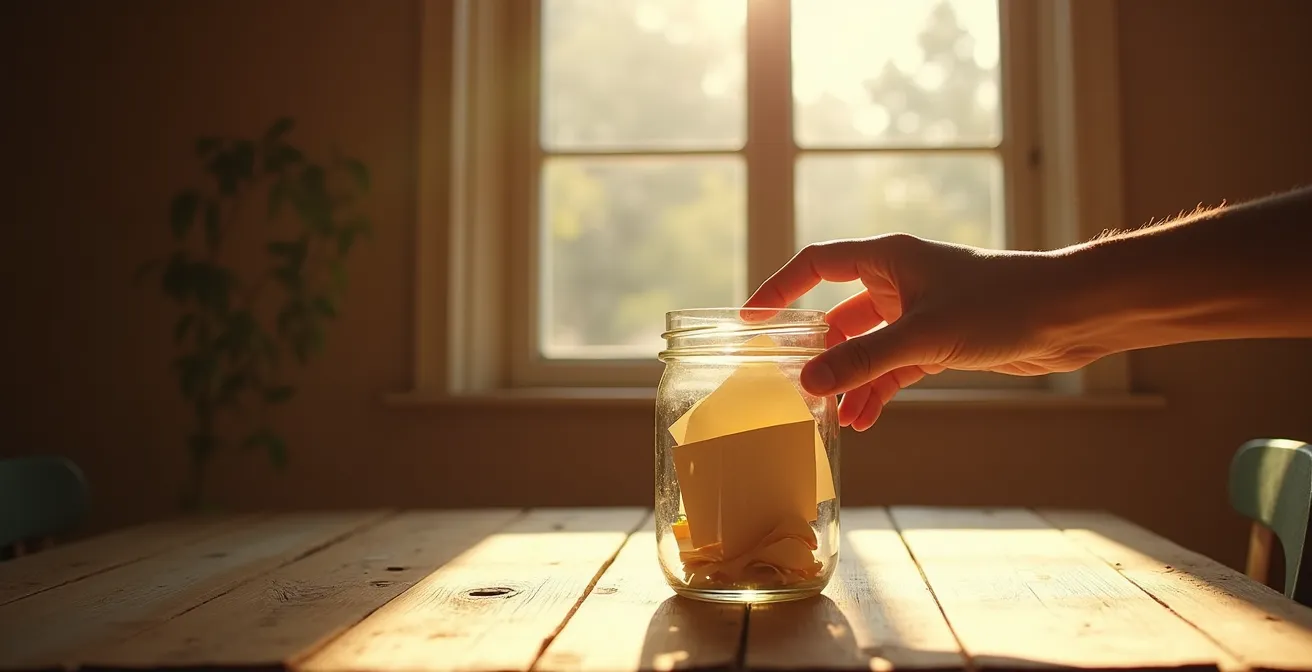
Building this habit can be a source of deep, quiet joy. Consider these approaches to weave gratitude into the fabric of your day:
- Start Small with a ‘One-Minute Anchor’: For those who struggle with focus, a simple, structured 60-second breathing exercise can be the perfect entry point.
- Create a Reciprocal Exchange: Start a daily “Three Good Things” text message chain with younger family members. It fosters connection and mutual appreciation.
- Build a ‘Story-Trigger Jar’: Write gratitude moments on small notes. Once a month, a family member can draw one and you can share the full story behind the moment.
- Frame it as an Heirloom: Think of your gratitude journal not just as a personal diary, but as a book of family blessings you are creating for the future.
- Engage the Senses: Mindfully interact with family heirlooms or prepare treasured recipes. Use these sensory experiences as bridges to grateful memories.
How to Encourage Participation in Digital Social Groups?
For many, the digital world can feel like a foreign country with a language they don’t speak. The idea of joining an online group can be intimidating, fraught with concerns about privacy, complexity, and not “fitting in.” Yet, these digital spaces hold immense potential for connection, learning, and sharing wisdom. The key to unlocking this potential is not to force participation, but to cultivate confidence and reframe the purpose.
The journey must begin with empowerment. As research in the *Journal of Medical Internet Research* shows, simply providing access to technology isn’t enough. The crucial first step is to increase self-efficacy through patient, supportive training. When a person feels competent and in control of the tool, their fear recedes and their curiosity grows. This initial training is the foundation upon which all future digital engagement is built.
Once confidence is established, the focus must shift to purpose. Instead of joining generic “senior forums,” it’s far more engaging to find groups centered on specific interests—gardening, history, classical music, woodworking. Most importantly, participation should be framed not as passive consumption of content, but as an active role. You are not there just to listen; you are there as a Wisdom Ambassador. You are there to share your unique perspective, your decades of experience, and your stories with a new and appreciative audience. This shift in identity from learner to mentor is transformative.
Your Action Plan: Becoming a Digital Wisdom Ambassador
- Build Your Foundation: Seek out or ask for training on the digital tools you want to use. Focus on one device or app at a time to build self-efficacy and confidence.
- Create a Safe Harbor: Start a private family group on a simple platform like WhatsApp or Facebook. Use this safe, familiar space to practice sharing photos, links, and messages.
- Follow Your Passion: Identify a lifelong hobby or interest and search for a digital group dedicated to it. Your existing knowledge will make you a valuable contributor from day one.
- Schedule Connections: Implement regular video calls with family, friends, or a “mini” from a program. Put these calls on your calendar to make them a consistent part of your life.
- Adopt the Ambassador Mindset: In every interaction, remind yourself that you are not just a participant, but a “wisdom ambassador.” Frame your comments and posts as opportunities to share your unique life experience.
Your story is a library waiting to be explored. The first step is simply to open the door. Begin today by sharing one small piece of your wisdom with someone younger. This is not just connection; it is the art of living fully, now.