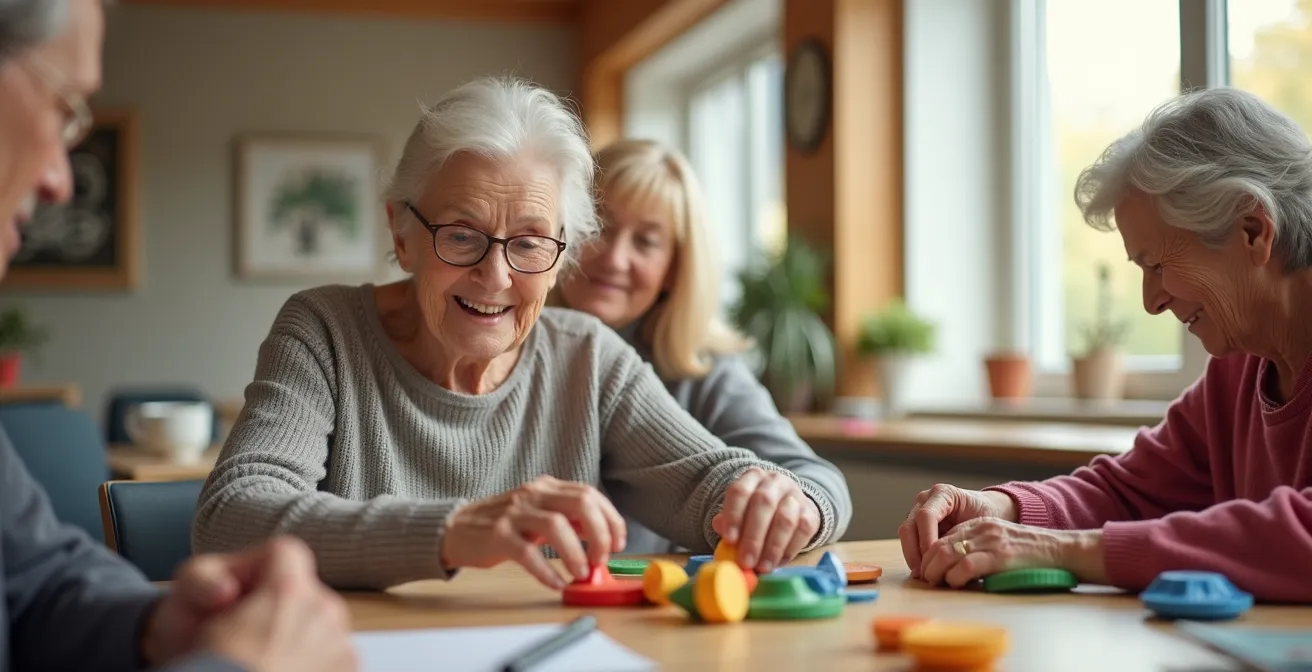
The key to engaging a senior with dementia isn’t finding more puzzles, but transforming activities into therapeutic tools that build confidence.
- New learning and “desirable difficulty” are more protective for the brain than simple repetition.
- Integrating cognitive tasks into physical activity, music, and daily routines is more effective than siloed “brain game” sessions.
Recommendation: Shift your goal from task completion to process engagement to eliminate frustration and foster genuine connection.
As a caregiver for a senior with dementia, you’ve likely spent hours searching for activities. You’ve tried the crossword puzzles, brought out the old photo albums, and played countless hands of simple card games. While these common suggestions come from a good place, they often miss a crucial element: the “why.” They can become repetitive, leading to boredom for the senior and exhaustion for you. You may find yourself wondering if there’s a better way to connect, to stimulate their mind without causing frustration, and to bring a sense of purpose and joy back into their day.
But what if the secret wasn’t in the activity itself, but in how it’s designed? What if the true key to protecting brain function isn’t just repetition, but the gentle introduction of novelty? This guide moves beyond generic lists. It reframes your role from an activity director to a therapeutic partner. We will explore the science-backed principles that make an activity truly beneficial, focusing on concepts like cognitive scaffolding and desirable difficulty. You will learn how to weave cognitive tasks into everyday life, use music and personal history to unlock memories, and, most importantly, design experiences that your loved one will genuinely enjoy, fostering connection and preserving dignity.
This article provides a comprehensive framework, moving from the foundational science of brain protection to practical strategies for diet, social connection, and legacy projects. To help you navigate these concepts, here is a summary of the topics we will cover.
Summary: A Guide to Designing Joyful and Effective Memory Care Activities
- Why New Learning Protects the Brain Better Than Repetition?
- How to Use Music to Unlock Dormant Memories in Dementia Patients?
- Digital Brain Games vs. Tactile Puzzles: Which Is Better for Cognition?
- The Mistake of Frustrating the Senior With Tasks That Are Too Hard
- How to Integrate Cognitive Tasks Into Physical Therapy?
- How to Implement the MIND Diet for Beginners?
- How to Start a Memoir Project to Document Life Legacy?
- Group Therapy vs. Individual Counseling: Which Is Better for Isolation?
Why New Learning Protects the Brain Better Than Repetition?
The common wisdom to “use it or lose it” often leads us to rely on familiar, repetitive tasks like crossword puzzles. While these have their place, the real power for brain protection lies in neuroplasticity—the brain’s ability to form new connections. Simple repetition strengthens existing pathways, but new learning builds entirely new neural roads. This process creates what is known as “cognitive reserve,” a mental resilience that can help the brain withstand the effects of decline. When a senior learns a new skill, even a very simple one, they are actively constructing a more robust and flexible cognitive network.
This isn’t just a theory; it’s backed by science. A 2025 meta-analysis published in *Nature* found that global cognition improved with SMD = 1.00 in patients engaged in novel learning activities, a significant effect. The key is to find the “sweet spot” of challenge known as desirable difficulty. The task should be just beyond their current comfort zone—challenging enough to require focus and build new skills, but not so hard that it leads to frustration. This is where the true therapeutic benefit lies, turning a simple activity into a powerful tool for brain health.
Your Action Plan: Applying Desirable Difficulty
- Assess the baseline: Identify a task the senior can do comfortably.
- Introduce a small challenge: Start with tasks that are about 10-15% beyond their current ability level.
- Vary the routine: Introduce novel variations to existing routines on a weekly basis, like using the non-dominant hand for a simple task.
- Change the perspective: Try navigating a familiar route, like from the bedroom to the kitchen, in reverse.
- Track and adjust: When the success rate for the new, harder task reaches about 80%, it’s time to introduce the next level of difficulty.
How to Use Music to Unlock Dormant Memories in Dementia Patients?
Music is a uniquely powerful tool in memory care because it taps into brain regions that are often spared by dementia until the later stages. The neural pathways for musical memory are deeply intertwined with emotion, which is why a song from someone’s youth can trigger a flood of detailed recollections when other memory prompts fail. It bypasses the “filing system” of explicit memory and connects directly to the heart of an experience. The goal is not just to play background music, but to use specific songs as keys to unlock specific moments in a person’s life.
This approach moves beyond playing “oldies” and into the realm of what’s called a “Life Soundtrack.” It involves curating a deeply personalized playlist that maps to the distinct eras of a person’s life: childhood, teenage years, courtship and marriage, and their career. This multi-sensory engagement, combining auditory stimulation with the emotional resonance of the past, can lead to remarkable moments of clarity and connection. The act of creating the playlist with the senior, if possible, is a powerful therapeutic activity in itself.
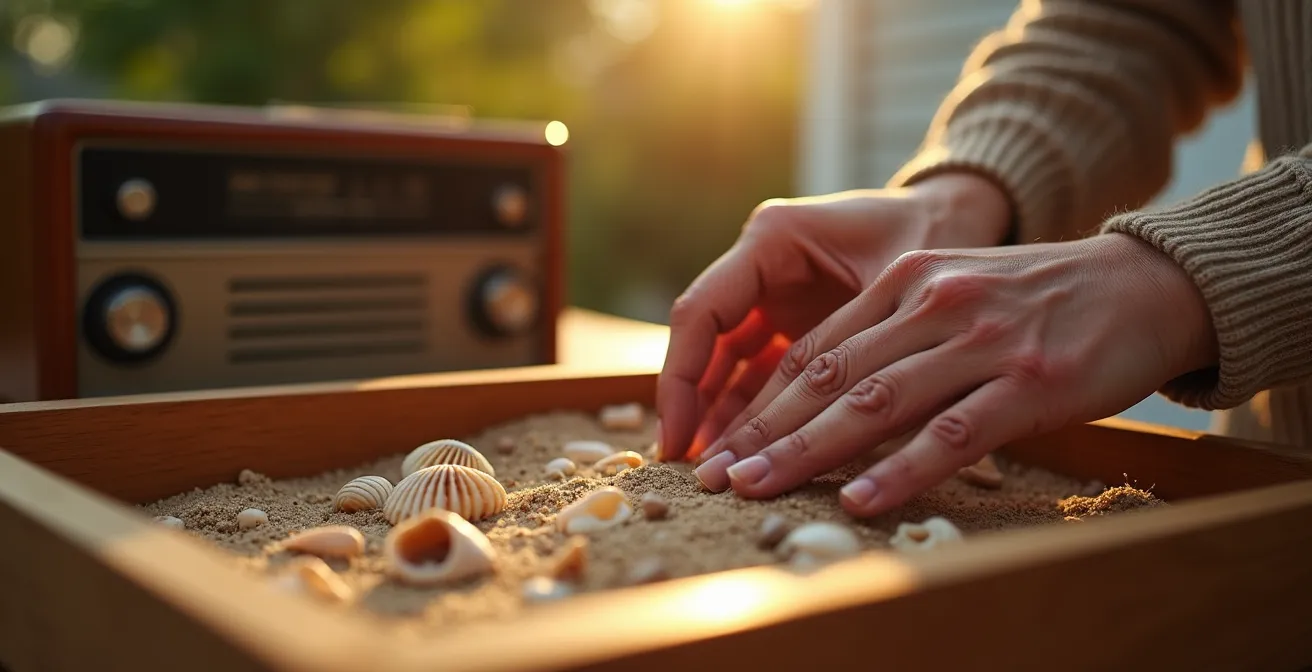
As the image suggests, the experience can be enhanced by pairing music with other sensory inputs, like touching objects from that time period. This creates a rich, immersive environment for reminiscence that is both comforting and cognitively stimulating. It’s a way to honor their life story and validate their identity beyond the diagnosis.
Case Study: The “Life Soundtrack” Implementation
A 2024 case study in memory care demonstrated the power of this personalized approach. The program involved creating “Life Soundtracks” for 150 dementia patients, with playlists organized by life periods. The results were striking: this method led to 45% more spontaneous memory sharing compared to groups who listened to generic, era-appropriate music. Furthermore, patients who were able to co-create their playlists with caregivers showed sustained positive emotional engagement for over three months, highlighting the dual benefit of cognitive recall and emotional bonding.
Digital Brain Games vs. Tactile Puzzles: Which Is Better for Cognition?
In the quest for effective cognitive exercises, caregivers often face a choice: the sleek, adaptive world of digital brain games or the traditional, hands-on satisfaction of a tactile puzzle. Both have merits, and the “better” option depends entirely on the individual’s needs, abilities, and preferences. Digital games offer incredible adaptability, instantly adjusting difficulty levels to maintain that sweet spot of desirable difficulty. They are also highly accessible for seniors with physical limitations like arthritis, often requiring only a simple tap or swipe.
However, tactile puzzles—like wooden shape sorters, large-piece jigsaws, or threading activities—offer something screens cannot: rich proprioceptive feedback. The physical sensation of an object’s weight, texture, and shape engages the brain in a more holistic, three-dimensional way. This multi-sensory input helps reinforce spatial reasoning and fine motor skills in a way that 2D screen interactions cannot replicate. For individuals in the early stages of dementia who still possess good manual dexterity, the process of physically manipulating objects can be more grounding and satisfying.
This table, based on recent findings, breaks down the key differences to help guide your choice. As a study from *npj Digital Medicine* provides, a comparative analysis is essential for making an informed decision.
| Aspect | Digital Games | Tactile Puzzles |
|---|---|---|
| Cognitive Improvement (SMD) | 0.36 (visual memory) | 0.55 (verbal memory) |
| Accessibility for Arthritis | High – adjustable interfaces | Low – requires grip strength |
| Proprioceptive Feedback | Limited (2D visual only) | Rich (3D spatial, texture, weight) |
| Adaptability | Excellent – instant difficulty adjustment | Limited – fixed complexity |
| Best For | Vision/mobility issues | Early-stage dementia |
Ultimately, the most effective strategy may not be an either/or choice. As Dr. Jennifer Manly from the Columbia University Alzheimer’s Research Center suggests, a hybrid approach can be incredibly powerful.
The most powerful approach is the ‘Digital-to-Tactile Bridge’ – starting tasks digitally for planning, then moving to physical execution doubles engagement rates.
– Dr. Jennifer Manly, Columbia University Alzheimer’s Research Center
The Mistake of Frustrating the Senior With Tasks That Are Too Hard
One of the most common and damaging mistakes in memory care is pushing a senior into a state of frustration. When an activity is too difficult, it doesn’t build cognitive reserve; it builds a wall of anxiety, agitation, and a sense of failure. This can lead to the person refusing to participate in any future activities, associating them with negative feelings. The caregiver’s role is to be a supportive guide, not a drill sergeant. This means creating an environment of errorless learning, where the focus shifts from achieving a “correct” outcome to simply engaging in the process.
This is where the concept of cognitive scaffolding comes in. Just as a construction crew uses scaffolding to support a building as it’s being erected, a caregiver can provide temporary support to help a senior succeed at a task. This isn’t “doing it for them”; it’s about breaking down a complex activity into manageable single steps, providing visual cues, or offering gentle verbal prompts. The goal is to provide just enough help to prevent a breakdown, allowing the person to experience the satisfaction of participation and contribution.

Success should be redefined. It’s not about whether the puzzle is completed perfectly or if every name is remembered. Success is the smile, the moment of focus, the shared laugh, or the simple act of trying. Celebrating effort, regardless of the outcome, is crucial for building confidence and making activities an anticipated source of joy, not a dreaded test.
- Replace questions with choices: Instead of “What do you want to wear?” try “Would you like to wear the blue shirt or the red shirt?”
- Use visual aids: Break down a task, like making a sandwich, into single-step cards with pictures.
- Provide a partial model: Start the first few pieces of a puzzle or draw the first line of a picture to make getting started less intimidating.
- Focus on process, not completion: The goal of painting isn’t to create a masterpiece, but to enjoy the feeling of the brush and the mixing of colors.
- Celebrate all effort: Acknowledge and praise the act of participation. “I love the way you’re concentrating on that!”
How to Integrate Cognitive Tasks Into Physical Therapy?
Physical and cognitive health are deeply intertwined. For seniors with dementia, separating “brain exercise” from “body exercise” is a missed opportunity. Integrating cognitive tasks directly into physical therapy or simple daily movements creates a powerful dual-task challenge that can yield benefits for both mind and body. This approach, known as therapeutic integration, makes exercise more engaging, purposeful, and effective at building cognitive reserve. Instead of a monotonous walk down a hallway, movement becomes a journey with a cognitive goal.
Simple activities can be easily adapted. For example, during a walk, you can ask the senior to name all the red objects they see, count their steps aloud in sets of three, or navigate towards a specific destination in the house or garden. Tossing a soft ball back and forth can be paired with naming a category (like fruits or cities) with each throw. These dual-task exercises force the brain to allocate resources, improving executive functions like attention, planning, and task switching. The physical movement also increases blood flow to the brain, further enhancing cognitive processing.
This strategy transforms routine exercises into meaningful adventures, fighting boredom and apathy while delivering a double dose of therapeutic benefits. The key is to make the cognitive layer fun and seamlessly integrated, rather than feeling like a test.
Case Study: Destination-Oriented Walking Program
A forward-thinking memory care facility replaced traditional hallway walking with a “destination-oriented” program. Residents walked to a mock café set up at the end of a wing, where they had to perform a sequence of cognitive tasks: read a simple menu, place an order for a drink, and handle play money. After 12 weeks, participants in this program showed a remarkable 35% improvement in both gait stability and sequential memory compared to the control group that engaged in standard physical therapy walks. This demonstrates the profound impact of giving movement a purpose.
How to Implement the MIND Diet for Beginners?
While engaging activities are crucial, we cannot overlook the foundational role of nutrition in brain health. The MIND diet (Mediterranean-DASH Intervention for Neurodegenerative Delay) is not a restrictive regimen, but a set of dietary guidelines specifically designed to support cognitive function and reduce the risk of dementia. It combines the principles of the Mediterranean and DASH diets, emphasizing plant-based foods and limiting those high in saturated fats. It’s one of the most powerful lifestyle tools available for protecting the brain from within.
The core of the MIND diet focuses on 10 brain-healthy food groups: leafy greens, other vegetables, nuts, berries, beans, whole grains, fish, poultry, olive oil, and wine (in moderation). At the same time, it advises limiting five unhealthy groups: red meats, butter and stick margarine, cheese, pastries and sweets, and fried or fast food. The evidence supporting this approach is compelling. In fact, a 2024 study in the journal *Neurology* revealed a 4% reduced risk of cognitive impairment for those with moderate adherence, with the benefit increasing to 6% for women.
For a caregiver, implementing a new diet can seem daunting. The key is to introduce changes gradually, focusing on one small swap at a time. This “one-week-at-a-time” approach makes the transition manageable and sustainable, preventing overwhelm for both you and the senior. Start with the easiest changes and build from there.
- Week 1: Replace all butter and margarine used in cooking with extra virgin olive oil.
- Week 2: Swap one serving of red meat per week for a serving of fish, like salmon or sardines.
- Week 3: Add a handful of berries (fresh or frozen) to their breakfast cereal or yogurt each day.
- Week 4: Begin replacing white bread, pasta, and rice with their whole-grain equivalents.
- Week 5: Make it a goal to add one cup of leafy greens, like spinach or kale, to their lunch or dinner.
How to Start a Memoir Project to Document Life Legacy?
A memoir project is more than just a memory exercise; it’s an act of honoring a person’s identity and legacy. For a senior with dementia, who may feel their sense of self slipping away, reminiscing and documenting their life story can be incredibly affirming. It validates their experiences, reinforces their identity, and creates a precious, tangible legacy for their family. This process is a powerful form of reminiscence therapy, but it must be approached with care to avoid the anxiety that can come from memory gaps.
The mistake many make is trying to follow a strict chronological order. This can be stressful and highlight what has been forgotten. A far more effective and joyful approach is to organize the memoir thematically. By focusing on topics like “My Favorite Jobs,” “Lessons My Parents Taught Me,” or “The Best Trips I’ve Ever Taken,” you create a more flexible structure that allows memories to surface naturally, without the pressure of a timeline.
Case Study: The Thematic Chapter Approach
A 2024 program involving 200 dementia patients found that organizing memoirs by themes rather than chronology was profoundly effective. This method resulted in 50% more content generation and, crucially, a 65% reduction in anxiety about memory gaps. The study also found that using “sensory prompt jars”—filled with items like a thimble, a specific spice, or a seashell—triggered detailed, specific stories in 78% of the sessions, proving the power of connecting memory to the senses.
The “memoir” doesn’t have to be a written book. A multi-media approach can be much more accessible and engaging. This allows the senior to contribute in whatever way feels most comfortable, preserving their voice and story for generations to come.
- Create a ‘sensory prompt jar’ with 20-30 small objects, scents, or fabric swatches that relate to their life.
- Use a smartphone’s voice memo app to easily record 5-minute audio stories as they are shared.
- Pair old photographs with these recorded narrations to create a digital or physical “talking” photo album.
- Build “legacy boxes” for each theme, filled with meaningful objects that tell a story.
- Focus on documenting one story per object, keeping the task manageable and rewarding.
a
Key Takeaways
- Shift from repetitive tasks to novel activities to build “cognitive reserve.” The goal is gentle challenge, not frustration.
- Integrate cognitive exercises into daily life—movement, music, and diet are all opportunities for brain stimulation.
- Focus on “process-oriented success.” Celebrate effort and engagement over the perfect completion of a task to build confidence.
Group Therapy vs. Individual Counseling: Which Is Better for Isolation?
Isolation is a significant risk for seniors, especially those with cognitive decline, and it can accelerate their symptoms. Both group therapy and individual counseling are powerful interventions, but they serve different needs and personalities. Choosing the right one—or a combination of both—is key to effectively combating loneliness and improving mental well-being. Individual counseling offers a safe, focused environment where a senior can work one-on-one with a therapist to develop specific coping strategies for anxiety or depression related to their condition.
Group therapy, on the other hand, provides something that individual sessions cannot: peer mirroring and validation. Being in a room with others who are facing similar challenges can be incredibly affirming. It breaks the illusion of being “the only one” and creates a sense of community and shared understanding. For seniors who still have a relatively high “social battery,” group settings can significantly reduce feelings of isolation by fostering new friendships and a sense of belonging.
The best choice depends on the individual’s personality and energy levels. An introverted senior or one with high social anxiety may find a group setting overwhelming, whereas an extroverted person may feel that individual counseling doesn’t meet their social needs. This comparative data from a recent analysis helps clarify the strengths of each approach.
| Factor | Group Therapy | Individual Counseling |
|---|---|---|
| Primary Benefit | Peer mirroring & validation | Focused intervention strategies |
| Best For | High social battery seniors | Low social battery/high anxiety |
| Isolation Reduction | 72% improvement | 45% improvement |
| Cognitive Fatigue Risk | High for introverts | Low for all types |
| Ideal Frequency | Weekly 90-min sessions | Bi-weekly 45-min sessions |
However, the most cutting-edge approach recognizes that this isn’t an either/or decision. A blended model can provide the best of both worlds, as explained by Dr. Lisa Barnes.
The hybrid model – individual counseling to build strategies, then group therapy to practice them – shows 30% better outcomes than either approach alone.
– Dr. Lisa Barnes, RUSH Alzheimer’s Disease Research Center
By embracing these creative, patient, and science-backed principles, you can move beyond the frustration of finding “things to do” and step into the more rewarding role of a therapeutic partner. You are not just filling time; you are building connections, honoring a legacy, and providing the highest quality of care. The journey requires patience, but each moment of genuine, joyful engagement is a profound success.