
Using a mobility aid isn’t a sign of giving up; it’s a strategic move to enhance your performance and independence.
- Reframing the device as “performance equipment” rather than a “crutch” fundamentally reduces feelings of stigma.
- Customization, correct sizing, and proper technique transform a medical device into a personal tool for environmental mastery.
Recommendation: Start by choosing the right device for your needs and practicing with it in the low-stakes environment of your own home to build confidence.
The decision to use a cane, walker, or rollator is rarely just a physical one. For many, it’s a deeply emotional moment, fraught with anxiety about perception. The fear isn’t about the device itself, but what it symbolizes: a perceived loss of youth, vitality, and independence. You might worry, “What will people think? Will they see me as frail or old?” This internal resistance can lead to delaying the use of a helpful tool, increasing the risk of falls and, ironically, leading to the very loss of independence you fear. Well-meaning friends might say, “Just don’t worry about it,” but this advice often falls flat because it ignores the very real social stigma at play.
The reality is that the need for assistive technology is becoming increasingly common. The World Health Organization projects that by 2050, the number of people needing at least one assistive product will rise, with many requiring more. This article moves beyond simplistic reassurance. As a social psychologist, my goal is to provide a new framework for thinking about mobility aids. We won’t just dismiss your feelings; we will actively work to reframe them. The key isn’t to ignore the cane in the corner, but to see it differently.
What if, instead of a symbol of decline, your mobility aid was a piece of performance-enhancing equipment? Like an athlete’s specialized shoes or a hiker’s trekking poles, these devices are tools for strategic energy management, designed to help you master your environment with greater confidence and safety. Throughout this guide, we will explore the cognitive strategies to make this mental shift, practical advice for choosing and personalizing your device, and confidence-building exercises to help you step out into the world not with shame, but with a renewed sense of empowerment.
This article provides a structured approach to move from resistance to acceptance and finally to empowerment. Below is a summary of the key areas we will cover to help you on this journey.
Summary: A New Perspective on Mobility and Independence
- Why Using a Device Actually Signals Independence, Not Frailty?
- How to Customize Mobility Aids to Reflect Personal Style?
- Cane Height vs. User Height: How to Measure Correctly?
- The Risk of Using Second-Hand Devices Without Safety Checks
- How to Practice Using a Device at Home Before Going Out?
- Choosing Between Rollators and Walkers Based on Terrain and Strength
- Applying Cognitive Behavioral Health Strategies for Senior Depression
- Why Push-Down Brakes Are Safer for Seniors With Arthritis?
Why Using a Device Actually Signals Independence, Not Frailty?
The most significant barrier to using a mobility aid is often the internal narrative we have about it. The thought, “This makes me look weak,” is a powerful deterrent. However, true independence isn’t about appearing strong; it’s about having the functional ability to live the life you want. A mobility aid is a tool that directly serves this goal. By offloading some of the work of balance and support, it frees up physical and cognitive resources. This is a form of strategic energy management. Instead of exhausting yourself with a short walk to the mailbox and having no energy left for the rest of the day, you use a tool to make that walk easier, preserving your stamina for activities you truly enjoy.
Consider the alternative. Refusing to use a device out of pride can lead to a shrinking world. You might avoid social outings, skip errands, or stay home on days when you feel less steady. This avoidance and isolation are the true thieves of independence, not the cane or walker that could prevent them. Proactively using a device demonstrates foresight, self-awareness, and a commitment to staying active and engaged in the world. It is a declaration that you are taking control of your mobility, rather than letting your physical limitations control you.
This mental shift is crucial. Viewing the aid as performance equipment, much like a cyclist uses a lightweight bike or a skier uses high-tech poles, changes the dynamic. It’s not about compensating for a deficit; it’s about optimizing your ability to perform. The device becomes an ally in your quest for autonomy, a smart choice that enables you to go farther, participate more fully, and remain a vibrant part of your community. It is an outward signal of an inner resolve to stay independent.
How to Customize Mobility Aids to Reflect Personal Style?
One of the primary reasons mobility aids carry a stigma is their traditionally clinical and sterile appearance. They often feel like an impersonal medical prescription rather than a personal possession. Reclaiming your device as an extension of your own identity is a powerful step in overcoming this stigma. When an aid reflects your personal style, it stops being a generic symbol of disability and becomes a unique accessory that expresses who you are. This transforms the narrative from “I have to use this” to “I choose to use this, and I’ve made it my own.”
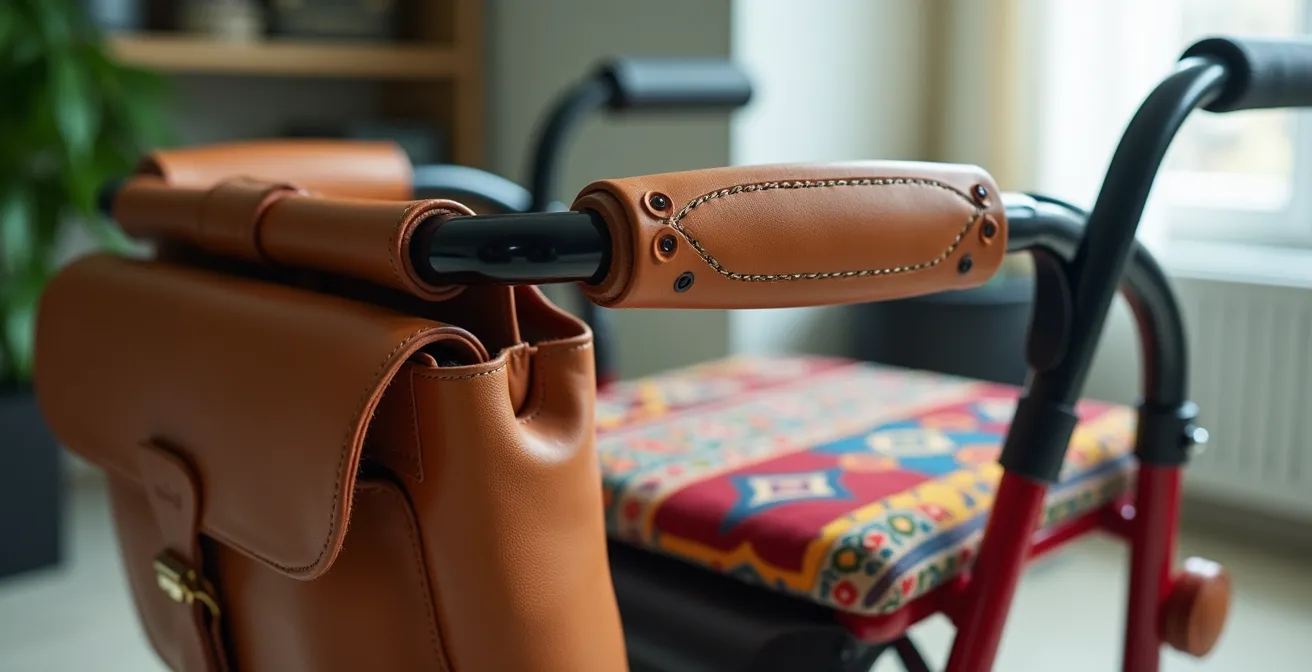
As the image above illustrates, customization can be both elegant and functional. Think beyond the standard-issue grey metal. Your mobility aid can be a canvas for self-expression. Consider these options:
- Color and Pattern: Many manufacturers now offer aids in a variety of colors. You can also use high-quality, durable paints or decorative tapes to add a personal touch.
- Accessorize: Add a stylish bag or basket that complements your personal taste. Choose elegant handle grips made from wood or leather. A custom fabric seat cover can add a pop of color and comfort to a rollator.
- High-End Design: A growing market of “inclusive design” focuses on creating devices that are aesthetically pleasing. As noted by experts in the field, devices designed to look modern or discreet can significantly reduce stigma.
The public perception of mobility aids is also changing, thanks in part to high-profile individuals who use them openly and stylishly. A powerful example is the case of actress Selma Blair, who has been a vocal advocate for normalizing mobility aids since her multiple sclerosis diagnosis. As reported in media outlets, Selma Blair’s public use of stylish canes and other devices has shown millions how this equipment can be an integrated and even fashionable part of life. By embracing her aids as part of her personal brand, she helps dismantle the pity and shame so often associated with them, turning them into symbols of resilience and style.
Cane Height vs. User Height: How to Measure Correctly?
Using a mobility aid that is improperly sized is not only uncomfortable but can be dangerous. A cane that is too tall or too short can negatively affect your posture, create new aches in your shoulder or back, and fail to provide the stable support you need, thereby increasing your fall risk. Ensuring your cane is the correct height is a critical step in making it an effective and safe tool. While many modern canes are adjustable, you must know the correct final height for your body.
The standard medical guideline for measuring cane height is simple and can be done at home:
- Wear Your Everyday Shoes: Stand as you normally would, wearing the type of shoes you wear most often.
- Relax Your Arms: Let your arms hang naturally at your sides.
- Measure to the Wrist: Have someone measure the distance from the floor up to the crease of your wrist. This measurement is the correct total height for your cane (from the tip to the top of the handle).
- Check Your Elbow Bend: When you hold the cane, your elbow should have a comfortable bend of about 20 to 30 degrees. This allows you to put weight on the cane for support without hyperextending or straining your arm.
This simple measurement ensures the cane works with your body, not against it. It’s a fundamental part of transforming the device from an awkward encumbrance into a seamless extension of yourself. This is particularly important as the type of cane you choose can also impact stability and function, making proper sizing even more essential.
| Cane Type | Height Adjustment | Best For | Key Features |
|---|---|---|---|
| Single Support Cane | Most are adjustable | Minimal support needs | Lightweight, foldable options |
| Tripod Cane | Usually adjustable | Greater stability needs | Three contact points, heavier |
| Quad Cane | Typically adjustable | Maximum stability | Four contact points, most stable |
The Risk of Using Second-Hand Devices Without Safety Checks
While acquiring a walker or rollator from a friend, family member, or thrift store can seem like a cost-effective option, it comes with significant hidden risks. Second-hand devices may have invisible wear and tear, hairline fractures, or worn-out components that compromise their structural integrity. A brake that fails or a frame that buckles at a critical moment can lead to a serious fall and injury, defeating the very purpose of the aid. Unlike a new device, a used one doesn’t come with a warranty or the assurance that it meets current safety standards.
The person who used the device before you may have had a different weight, height, or pattern of use, placing stress on parts of the frame that aren’t immediately obvious. Rubber tips on canes and walkers wear down, reducing their grip. Brake cables on rollators can stretch, and wheel bearings can become loose. Without a thorough inspection by someone who knows what to look for, you are essentially placing your trust—and your physical safety—in an unknown quantity. The initial savings are not worth the potential cost of a fall-related injury, hospitalization, and subsequent loss of independence.
If you must consider a second-hand device, performing a rigorous safety inspection is non-negotiable. Treat it like inspecting a used car; you need to look under the hood. Go through a systematic checklist to identify any potential points of failure before you put your weight on it. If you are not confident in your ability to perform these checks, it is far safer to invest in a new, properly fitted device or have the used one inspected by a professional medical equipment supplier.
Your Action Plan: Safety Inspection for Second-Hand Mobility Devices
- Structural Integrity: Carefully check the entire frame for hairline cracks, bends, or stress marks, especially around joints and welds.
- Brake Systems: Test all brake mechanisms thoroughly. For rollators, check that the brakes lock securely and that the cable tension is firm.
- Wheels and Tips: Inspect the wheels for smooth rotation and check the bearings for looseness. Examine all rubber tips and grips for significant wear, replacing any that are worn smooth.
- Folding and Locking: Verify that any folding mechanism operates smoothly and, most importantly, that the locking systems engage securely to prevent accidental collapse.
- Weight Capacity Test: Before regular use, test the device’s stability by gradually applying your weight to it in a safe environment, listening for any creaks or signs of strain.
How to Practice Using a Device at Home Before Going Out?
The fear of being judged in public is a major source of anxiety. One of the most effective psychological techniques for overcoming this is “graduated exposure,” which involves starting small and building up your confidence in controlled environments. Your home is the perfect private training ground. Before you take your new walker or cane on a public outing, spend time mastering its use within the safety of your own walls. This practice isn’t just about the mechanics; it’s about building a new physical and emotional relationship with the device, making its use feel like second nature.
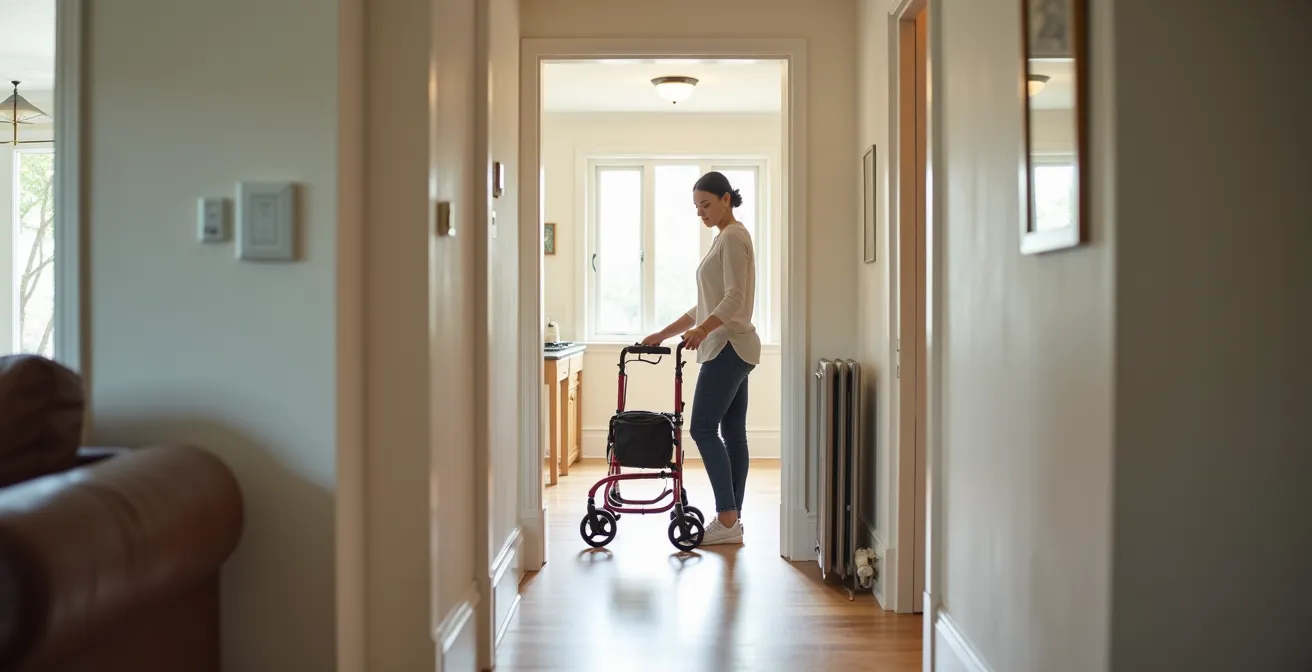
Create a “mobility obstacle course” in your home. Practice maneuvering through doorways, navigating around furniture, and turning in tight spaces like hallways or the kitchen. If you have a rollator, practice engaging the brakes and using the seat to rise and sit down. If you have a cane, practice walking on different surfaces, like the transition from a wood floor to a rug. The goal is to make your movements so fluid and automatic that you no longer have to consciously think about them. This frees up your mental energy when you do go out, allowing you to focus on your surroundings and your destination, not on your feet.
This methodical approach has been shown to be highly effective. For example, Ardra Shephard, who lives with progressive Multiple Sclerosis, shared her experience using this exact technique. She began by using her devices at home, then progressed to short, low-stakes trips like walking to the mailbox. From there, she moved to quiet stores during off-peak hours, gradually building her comfort level and desensitizing herself to the social anxiety associated with public use. This systematic process builds confidence one step at a time, making the eventual transition to busier public spaces feel far less daunting.
Choosing Between Rollators and Walkers Based on Terrain and Strength
Not all mobility aids are created equal, and choosing the right one for your specific needs is crucial for both safety and confidence. The two most common options, standard walkers and rollators, serve very different purposes. A standard walker, which has no wheels and must be lifted with each step, offers maximum stability. It is an excellent choice for individuals who need to place significant weight on the device for support, especially for short distances on flat, indoor surfaces. However, its “lift-and-place” nature requires good upper body strength and can be cognitively demanding and slow over longer distances.
A rollator, on the other hand, is a walker with wheels (usually three or four) and hand brakes. It is designed for mobility rather than pure weight-bearing. Because it can be pushed forward, it allows for a more natural, continuous gait and is far better suited for covering longer distances and navigating varied terrain like sidewalks or gentle slopes. Most rollators also come with a built-in seat and a basket, which grants a significant degree of autonomy. The ability to take a rest whenever needed without searching for a bench can be the deciding factor in whether someone attempts a social outing or a trip to the store.
The choice between the two often comes down to a trade-off between stability and mobility. An individual with significant balance issues or weakness who needs to put their full weight on the device is safer with a standard walker. Someone who is relatively steady on their feet but has endurance issues will find that a rollator gives them the freedom and confidence to stay active and engaged. The table below outlines the key differences to help guide your decision.
| Feature | Standard Walker | Rollator |
|---|---|---|
| Weight Support | Maximum stability | Moderate support with mobility |
| Cognitive Load | High (requires lifting) | Low (just push forward) |
| Terrain Handling | Best for indoor flat surfaces | Better for varied terrain with wheels |
| Rest Options | None – need external seating | Built-in seat for autonomy |
| Storage | Usually none | Often includes baskets/bags |
| Best For | Short distances, maximum support | Longer distances, social activities |
Applying Cognitive Behavioral Health Strategies for Senior Depression
The emotional resistance to using a mobility aid is often rooted in deeply ingrained, automatic negative thoughts. These thoughts are the target of Cognitive Behavioral Therapy (CBT), a highly effective psychological approach. CBT works by helping us identify, challenge, and reframe the unhelpful thought patterns that lead to negative feelings and behaviors (like avoiding the use of a walker). The core idea is that it’s not the event itself (using a cane) that causes distress, but our interpretation of it (“Everyone thinks I’m old and frail”).
One powerful CBT technique is the “thought record.” This involves actively noticing and writing down the automatic thought that pops into your head when you think about using your aid. For example: “If I use this walker at the grocery store, everyone will stare at me.” Once identified, you challenge this thought:
- Examine the Evidence: Are people really staring, or are you assuming they are? Most people are focused on their own shopping. This challenges the cognitive distortion of “mind reading.”
- Consider an Alternative: Reframe the thought to something more balanced and realistic. “I can’t read their minds. I am here to get my groceries and stay active. This tool allows me to do that safely.”
- Behavioral Activation: A key part of CBT involves changing behavior to improve mood. In this context, using the mobility aid is framed as the key to re-engaging in valued activities, such as visiting a friend or going to the library.
This process is not about pretending the negative feelings don’t exist; it’s about actively challenging the thoughts that fuel them. As described in a CBT approach to mobility aid acceptance, the goal is to systematically restructure these thoughts. It’s about building disability pride and redirecting the energy you spend fighting reality into actively participating in your life. By changing your thoughts, you change your feelings, which in turn makes it easier to change your behavior and embrace the tools that grant you freedom.
Key Takeaways
- Push-down brakes provide a stable, “parked” base, which is crucial for users with arthritis or low grip strength.
- This type of brake is mechanically superior for situations requiring significant weight support, such as rising from a seated position.
- Understanding the difference between push-down (parking) and loop (active) brakes is essential for choosing the safest rollator for your condition.
Why Push-Down Brakes Are Safer for Seniors With Arthritis?
For a rollator user, the brakes are arguably the most important safety feature. While many rollators use loop-style brakes that function like a bicycle’s hand brakes, this design can be challenging and even dangerous for seniors with arthritis, diminished grip strength, or hand tremors. Squeezing and holding a lever requires a degree of hand strength and dexterity that may not always be available. A far safer alternative for many is the push-down brake system. This mechanism functions differently: instead of squeezing a lever, you simply apply downward pressure on the handles until the brake locks into a “parked” position.
This “set it and forget it” functionality is a significant biomechanical advantage. As noted by healthcare professionals in comparative analyses, a key moment of high fall risk is the transition from sitting to standing. A person with arthritis needs to put significant weight on the rollator to push themselves up. With loop brakes, they would have to simultaneously squeeze the brakes while pushing up, which is often impractical. With push-down brakes, they can lock the rollator into a completely stable base, lean on it with full confidence, and then release the brakes once they are standing securely. The device becomes a fixed, reliable piece of support furniture precisely when it’s needed most.
This safety benefit extends beyond just arthritis. Individuals with Parkinson’s disease or other conditions that cause hand tremors may find it difficult to modulate the pressure on a loop brake, whereas a push-down brake offers a simple, binary on/off state. The choice of brake system is not a minor detail; it is a critical safety consideration that should be tailored to the user’s specific physical abilities. For many, the push-down brake is the feature that transforms a rollator from a potential hazard into a truly trustworthy mobility partner.
The journey from resisting a mobility aid to embracing it is a profound psychological shift. It begins with the decision to reframe the device not as a symbol of loss, but as a proactive choice for a better, more engaged life. The next logical step is to choose one small technique from this guide—whether it’s reframing a single thought, measuring for a new cane, or simply practicing in the hallway—and start today. Your independence is waiting.