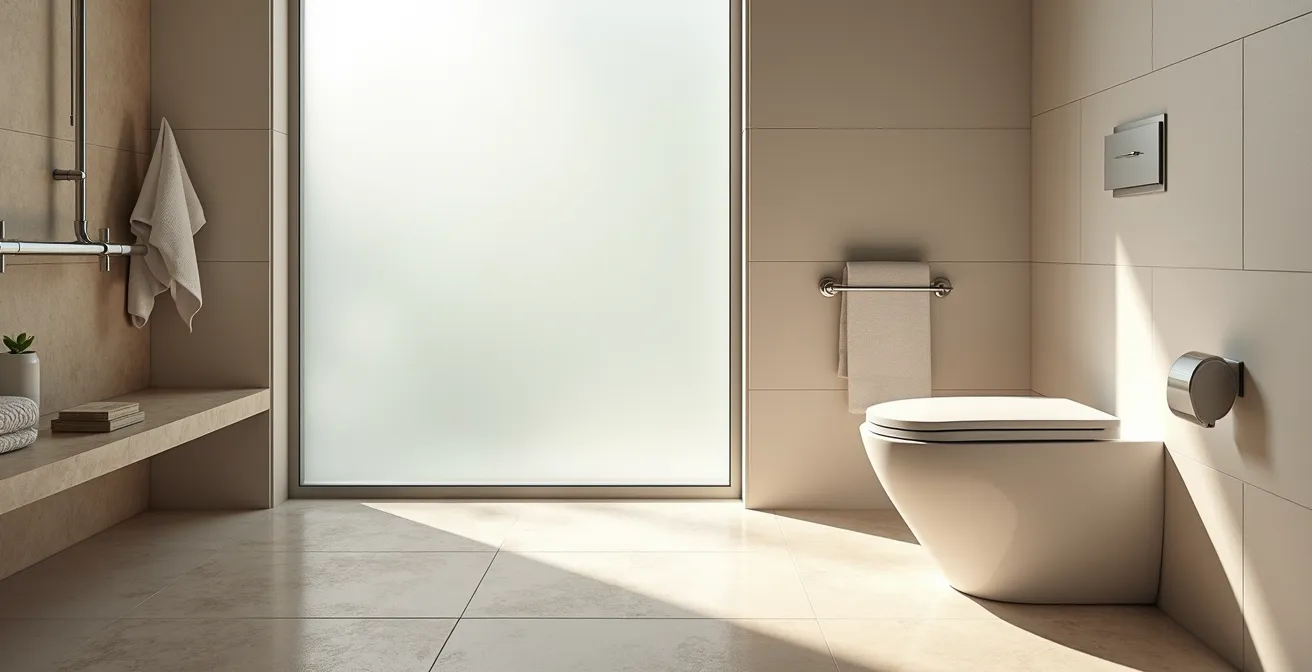
The common belief that bathroom safety must look clinical and devalue your home is a myth.
- Integrated, design-forward solutions preserve aesthetics and function better than temporary, bolt-on medical equipment.
- Focusing on structural integrity and permanent installations like comfort-height toilets and properly anchored grab bars adds long-term value.
Recommendation: Shift your mindset from “adding safety features” to “upgrading your bathroom with universal design principles” for a result that is both beautiful and secure.
The decision to make a bathroom safer often comes with a sense of dread. We picture cold, sterile grab bars, clunky plastic toilet seat risers, and rubber mats that turn a personal sanctuary into a space that feels more like a hospital ward. This fear is valid. For many homeowners planning for their future, the idea of sacrificing decades of curated style—and significant resale value—for safety is a bitter pill to swallow. The immediate goal is to prevent falls, but the unspoken fear is a loss of dignity, independence, and the very character of one’s home.
The conventional approach often defaults to these conspicuous, medical-grade accessories because they seem like a quick fix. But what if this entire premise is flawed? What if the most effective safety measures are the ones you don’t immediately notice? As a design architect specializing in creating beautiful, functional spaces for life, I can tell you that the key isn’t to bolt on safety; it’s to build it in. It’s about making intelligent, integrated design choices that are both aesthetically pleasing and fundamentally secure.
This guide moves beyond the clinical clichés. We will explore how to select and install features that enhance security without compromising on style. From invisible anti-slip floor treatments to elegant grab bars that double as towel racks, we will reframe bathroom safety not as a medical necessity, but as a smart, sophisticated home upgrade that protects both your well-being and your investment.
In the following sections, we will deconstruct the process of a design-conscious bathroom retrofit. You’ll learn how to approach everything from flooring and fixtures to the critical timing of renovations, ensuring every choice contributes to a space that is welcoming, valuable, and, above all, safe.
Summary: Retrofitting Bathroom Safety Features Without Destroying Resale Value
- Why “Clinical” Bathroom Design Increases Resistance to Usage?
- How to Apply Anti-Slip Treatments to Tiles Without Changing the Look?
- Comfort Height Toilets vs. Risers: Which Is More Stable?
- The Error of Installing Grab Bars Into Drywall Instead of Studs
- When to Schedule Bathroom Retrofits Before Elective Surgery?
- Selecting Transfer Benches for Bathtubs with Glass Enclosures
- Choosing Electric Patient Lifts for Home Use with Narrow Doorways
- Managing Accessible Housing Transitions Without Emotional Trauma
Why “Clinical” Bathroom Design Increases Resistance to Usage?
The biggest failure of a safety feature is when it goes unused. This often happens not because it’s ineffective, but because of what it represents psychologically. When a bathroom is filled with obvious, institutional-looking equipment, it constantly reminds the user of their vulnerability. This can create a powerful form of psychological resistance. Instead of feeling safer, a person may feel older, more fragile, or “like a patient” in their own home, leading them to avoid or resent the very things meant to help them.
A bathroom should be a place of privacy and dignity. Introducing elements that scream “disability” can erode that sense of self-reliance. This isn’t just about vanity; it’s about mental well-being. A design that feels imposed by medical necessity rather than chosen for comfort and style can lead to feelings of depression or a loss of identity. The user may actively bypass a grab bar that looks like it belongs in a hospital because using it feels like an admission of defeat.
The stakes are incredibly high. Data from the CDC confirms that falls are a serious threat; in fact, 37% of seniors who fall report injuries requiring medical attention. Therefore, the goal of a successful retrofit is to make the safe choice the easy and desirable choice. By integrating safety into beautiful, high-end design—a heated floor that is also non-slip, a sturdy and elegant bench in the shower—we remove the psychological barrier. The features become part of a luxurious experience, encouraging their use naturally and preserving the user’s sense of independence and self-worth.
How to Apply Anti-Slip Treatments to Tiles Without Changing the Look?
One of the greatest fears in bathroom retrofitting is ruining beautiful, expensive tile with gritty coatings or unsightly mats. Fortunately, modern material science offers solutions that provide “invisible grip” without sacrificing aesthetics. The key is to understand the industry standard for measuring slip resistance: the Dynamic Coefficient of Friction (DCOF). A higher DCOF rating means more grip, especially in wet conditions.
For a design-forward approach, there are two primary routes: selecting the right tile from the start or treating existing tile. When choosing new tile, look for textured porcelain with a manufacturer-stated DCOF of at least 0.42. Many high-end tiles now come with subtle, stone-like textures that are inherently slip-resistant. Another architectural trick is to use smaller tiles, like 2×2 inch mosaics, particularly on the shower floor. The increased number of grout lines naturally provides more edges for your feet to grip, enhancing safety without a single additive.

If you love your existing tiles, the best option is often micro-etching. This is a professional treatment where a liquid solution is applied that creates microscopic, invisible-to-the-naked-eye texture on the tile surface. When the floor is dry, it looks exactly the same. When wet, these micro-treads provide significant grip, dramatically increasing the DCOF rating. Unlike applied coatings, it’s a permanent change to the tile itself and won’t peel or yellow over time. The table below compares the most common options.
| Treatment Type | DCOF Rating | Durability | Visual Impact |
|---|---|---|---|
| Micro-etching | 0.42-0.55 | Permanent | Minimal when wet |
| Clear coatings with grit | 0.45-0.60 | 3-5 years | Slight sheen change |
| Textured porcelain (original) | 0.42-0.70 | Lifetime | Design integrated |
Comfort Height Toilets vs. Risers: Which Is More Stable?
The toilet is a high-risk area for falls, as the motion of sitting and standing requires significant strength and balance. With approximately 235,000 people injured in bathroom falls each year in the U.S. alone, choosing the right solution is critical. The common quick fix is a portable toilet seat riser—a plastic, elevated seat that clamps onto the existing bowl. While inexpensive, these risers are often unstable, can shift during use, and are difficult to clean. Aesthetically, they are the epitome of clinical, medical equipment.
From both a design and safety perspective, the superior solution is a comfort height toilet. These are toilets designed with a bowl height of 17 to 19 inches (versus the standard 14-15 inches), making them roughly the height of a standard chair. This is not a “special” toilet; it’s an ADA-compliant standard that is now widely available in countless modern, elegant designs from all major manufacturers. The higher seat level significantly reduces the strain on knees and back, making the process of sitting and standing far easier and safer.
The key difference is stability. A comfort height toilet is a single, solid porcelain fixture securely bolted to the floor. There are no moving parts to shift or break. It becomes a permanent, integrated part of the bathroom that anyone can use comfortably, without feeling like they need an “aid.” This is a perfect example of a universal design choice that adds value and safety simultaneously, eliminating the need for a temporary, unstable, and unsightly riser. When paired with a discreet, properly installed grab bar, it provides a secure and dignified experience.
The Error of Installing Grab Bars Into Drywall Instead of Studs
A grab bar is only as strong as its anchor. The single most dangerous mistake in a bathroom safety retrofit is improperly installing a grab bar. Attaching it directly to drywall, even with plastic anchors, is a recipe for disaster. Drywall is simply compressed gypsum and paper; it has no structural strength and will not support the sudden, dynamic force of a person slipping and grabbing for support. A grab bar that pulls out of the wall at the moment of need is more dangerous than no grab bar at all.
For a grab bar to be effective, it must be anchored directly into the wall studs—the vertical wooden beams that form the frame of the wall. This provides a solid, load-bearing foundation capable of supporting hundreds of pounds of force. A design architect or a qualified contractor will always use a stud finder to locate these supports before drilling a single hole. In a perfect world, studs are exactly where you need them for optimal grab bar placement.
However, if the studs aren’t in the ideal location, there are professional solutions. The best is to install solid wood blocking. This involves opening the wall to place a horizontal piece of lumber securely between two studs, creating a solid anchor point exactly where you need it. While more invasive, this is the gold-standard method. If opening the wall is not an option, specialized hollow-wall anchoring systems (like WingIts or Toggler Snaptoggles) are designed to distribute the load over a wider area of the drywall and can provide a secure mount, but direct stud-anchoring remains superior.
Checklist for Secure Grab Bar Installation
- Locate and mark all wall studs in the installation area using a reliable electronic stud finder.
- Select a grab bar rated to support at least 250 pounds, with a textured surface for better grip.
- If studs are not ideally placed, plan to install solid wood blocking between the studs for a secure anchor point.
- Use stainless steel screws long enough to penetrate at least 1.5 inches into the stud or blocking.
- Test the installed bar by applying your full body weight to it before considering the job complete. Ensure there is no flex or movement.
When to Schedule Bathroom Retrofits Before Elective Surgery?
Proactive planning is the difference between a stressful, rushed job and a thoughtful, well-executed design upgrade. This is especially true when preparing a home for recovery after an elective surgery like a hip or knee replacement. The worst time to start thinking about bathroom safety is the week before the procedure, or worse, the day you come home. At that point, you are forced to accept whatever is available, which usually means clinical, temporary equipment and a higher risk of accidents.
As a rule of thumb, all modifications should be completed 4 to 6 weeks before the surgery date. This provides a crucial acclimation period. It allows you to get used to the new layout, the feel of the grab bars, and the height of the toilet while you are still healthy, mobile, and not in pain. It also provides a buffer to fix any small issues that may arise. Furthermore, starting the process 3-6 months out is wise, as high-quality, design-forward fixtures often have lead times and good contractors are booked in advance.

This proactive timeline is critical, especially when you consider how unprepared most homes are. Shockingly, recent estimates indicate only 10% of American homes are aging-in-place ready. By planning ahead, you transform the narrative from a reactive medical crisis to a proactive home improvement project. It becomes a shared goal, an opportunity to choose beautiful tiles and fixtures together, ensuring the final result is a space you love, not just a space you need.
Selecting Transfer Benches for Bathtubs with Glass Enclosures
Bathtubs with sliding glass doors present a significant challenge for traditional bathroom safety. The metal track for the doors prevents the use of a standard transfer bench, which needs to sit flat across the tub edge. This often leads people to believe their only option is a costly, full-scale renovation to remove the tub and doors entirely. However, several design-forward solutions can bridge this gap effectively.
One of the most elegant and integrated solutions is a wall-mounted, fold-down seat installed directly inside the shower/tub enclosure. These seats are available in beautiful materials like water-resistant teak or sleek solid surfaces that can match the bathroom’s decor. When not in use, they fold up flush against the wall, taking up minimal space and maintaining clean visual lines. When folded down, they provide a stable, secure place to sit while showering, eliminating the need to transfer over the tub wall.
If a bench is still preferred, there are specialized tub-mounted transfer benches. These models have adjustable legs and a mechanism that clamps securely onto the tub wall itself, arching over the door track. Another option is a rotating seat model, which minimizes the difficult “scooting” motion required on a standard bench. While these are more functional than aesthetic, they represent a better solution than forgoing safety altogether. For long-term planning, it’s also worth considering a full conversion to a curbless, barrier-free shower, which is the gold standard for accessibility and has a modern, high-end appeal.
Choosing Electric Patient Lifts for Home Use with Narrow Doorways
In situations where mobility is severely limited, an electric patient lift may become necessary. This introduces the most significant risk of a “clinical” feel, but even here, design-conscious choices can make a difference. The biggest obstacle is often space, particularly narrow doorways common in older homes. A standard floor lift (often called a Hoyer lift) requires wide clearances to maneuver, which may not be feasible.
The most integrated and least obtrusive solution for homes with space constraints is a ceiling track lift. This system consists of a permanent track installed on the ceiling, with a motorized lift unit that glides along it. It requires no floor space, eliminates the struggle of pushing a bulky lift over carpets and thresholds, and can be designed to run from a bedroom directly into the bathroom. While the track is visible, it is far more discreet than having a large floor lift parked in a corner. The installation is permanent, but it can be a major selling point for future buyers needing accessible features.
As the Re-Bath Design Specialists note, structural modifications are often the most effective solution for long-term accessibility. As they state in their “6 Bathroom Safety Tips for Seniors & Elderly”:
Doorways should be widened to a minimum of 32 inches in order to accommodate walkers and wheelchairs
– Re-Bath Design Specialists, 6 Bathroom Safety Tips for Seniors & Elderly
This advice underscores the universal design principle of making the space itself accessible, rather than relying solely on equipment. The following table outlines the trade-offs between different lift types.
| Lift Type | Space Required | Installation | Resale Impact |
|---|---|---|---|
| Ceiling Track | Minimal floor space | Permanent ceiling mount | Can be removed |
| Floor/Hoyer Lift | 36+ inch doorways | No installation | No structural changes |
| Pressure-Fit Overhead | Floor to ceiling poles | No permanent installation | Fully removable |
Key Takeaways
- Choose permanent, integrated solutions (comfort height toilets, built-in benches) over temporary, clinical add-ons (risers, plastic seats) for better safety and aesthetics.
- Structural integrity is paramount. Never anchor grab bars into drywall alone; always secure them to wall studs or professionally installed blocking.
- Plan ahead. Completing renovations 4-6 weeks before a planned surgery allows for an acclimation period and avoids rushed, poor-quality decisions.
Managing Accessible Housing Transitions Without Emotional Trauma
The entire process of retrofitting a home for safety is, at its core, an emotional journey. It’s about navigating change, confronting the future, and preserving a sense of self. The most successful transitions are those managed not as a medical mandate, but as a proactive choice toward a better quality of life. The key is to frame the project around a philosophy known as Universal Design.
Universal Design is not about designing for the elderly or disabled; it’s about designing for everyone. It’s about creating spaces that are inherently flexible, comfortable, and usable by people of all ages and abilities without modification. A curbless shower, for example, is easier for a wheelchair user, but it’s also a sleek, modern design feature that a young family will appreciate for its ease of cleaning and open feel. A beautiful lever-style door handle is easier for someone with arthritis to open, but it’s also more convenient for anyone carrying groceries. As design expert Jillian Lare explains:
Universal Design is the design of space so that it can be utilized and enjoyed to its full extent by as many people as possibly regardless of their ability, including age, mobility, vision, hearing
– Jillian Lare, How to Design a Safe and Stylish Bathroom for Aging in Place
When you adopt this mindset, the emotional trauma of “giving in” to safety modifications disappears. You are no longer “disability-proofing” your home; you are upgrading it to a higher standard of comfort and convenience for the long term. This approach empowers you, putting you in the driver’s seat of your home’s evolution.
Case Study: Proactive Upgrade as a Lifestyle Choice
Vincent Catalano, 62, of Sacramento, exemplifies this mindset. He installed a curbless shower with a handheld sprayer and a built-in bench “with the presence of mind for aging in place,” he says. “There’s no door on the shower; you just walk right in.” By taking ownership of these modifications before they were urgently needed, he transformed them from a potential medical necessity into a desirable lifestyle upgrade that enhances his daily life now.
Ultimately, a successful transition is one where the homeowner feels a sense of pride in the result. By focusing on beautiful, integrated, universal design principles, you create a space that not only protects your physical safety but also nurtures your emotional well-being and enhances the value of your home for years to come.
The next logical step is to stop thinking in terms of individual features and start developing a cohesive universal design plan for your bathroom. Evaluate your space not for its current limitations, but for its future potential to be both beautiful and universally accessible.