
For caregivers, the physical toll of frequent doctor visits and travel is a major source of strain. Choosing a transport chair based solely on the senior’s needs ignores the person doing the pushing and lifting. This guide reframes the selection process around caregiver ergonomics, demonstrating how focusing on ultra-lightweight design, caregiver-operated brakes, and proper dimensions is not a luxury, but a critical strategy to prevent chronic back injury and reduce the logistical stress of every single outing.
The familiar ache in your lower back after hoisting a mobility aid into the car trunk. The subtle dread before an appointment, not because of the visit itself, but because of the physical logistics involved. For millions of caregivers, this is a silent, daily reality. Most guides on choosing a transport chair focus on the passenger’s comfort, seat size, and portability—all valid points. They discuss the convenience of folding chairs for travel and the importance of a smooth ride.
But what if the most crucial factor has been overlooked? The relentless, repetitive strain placed on the caregiver’s body. The act of lifting, pushing, and maneuvering a chair, day after day, creates a cumulative load on muscles and joints. This is where the standard advice falls short. The true key to selecting the right transport chair lies in shifting the focus: it is an ergonomic tool for the caregiver as much as it is a mobility aid for the senior. It’s an investment in your own long-term health and a strategy for preserving your energy.
This article will deconstruct the transport chair not by its features alone, but by how each feature impacts you, the caregiver. We will analyze everything from frame weight to brake mechanics through the lens of ergonomics and stress reduction, providing a clear path to choosing a chair that makes every trip safer and less taxing for everyone involved.
To navigate this essential decision, this guide breaks down the key considerations into a clear, actionable framework. The following sections will equip you with the expert knowledge needed to assess each aspect of a transport chair from a practical, caregiver-focused perspective.
Summary: A Caregiver’s Ergonomic Guide to Transport Chairs
- Why “Ultra-Lightweight” Transport Chairs Save Caregiver Backs?
- Reviewing Seat Width and Padding for waiting room sits
- Companion Brakes vs. Wheel Locks: Which Is Safer on Ramps?
- The Mistake of Expecting the Senior to Propel a Transport Chair
- How to Gate-Check a Transport Chair Without It Getting Damaged?
- Choosing Between Manual and Power Wheelchairs for Long-Term Shoulder Health
- Utilizing Respite Care Services Without Guilt or Anxiety
- Why Google Maps Accessibility Features Are Essential for Trip Planning?
Why “Ultra-Lightweight” Transport Chairs Save Caregiver Backs?
The term “lightweight” is often used in marketing, but for a caregiver, its meaning is deeply physical. It’s the difference between a manageable lift and a risky one. The core principle of caregiver ergonomics is to minimize the force required for any task. When lifting a transport chair into a trunk, you are engaging in a biomechanically vulnerable movement. The strain isn’t from a single lift; it’s the cumulative load from dozens or hundreds of transfers over months and years. This repetitive strain is a primary cause of chronic back pain and injury among caregivers.
Statistics are stark: studies have shown that for professional caregivers, a staggering 80% of all injuries result from lifting, pulling, pushing, and other patient handling tasks. While family caregivers may not face the same volume, the risk is identical. An “ultra-lightweight” transport chair, often weighing as little as 15 pounds, fundamentally changes the ergonomic equation. Compared to a standard 25-30 pound model, it cuts the lifting force required by nearly half. This reduction is even more critical for spousal caregivers who may have their own physical limitations.
This weight advantage extends beyond lifting. A lighter chair requires less inertia to get moving, less force to stop, and less effort to navigate tight corners in a crowded clinic. A real-world example like the Medline Ultralight Transport Wheelchair, noted for its 15-pound frame, is specifically praised as being “especially ideal for caregivers, who may not be the strongest people themselves, or who need to lift the chair in and out of a trunk frequently.” Choosing the lightest possible chair that still meets the senior’s weight capacity isn’t a minor upgrade; it’s the single most effective decision you can make to protect your own body.
Reviewing Seat Width and Padding for waiting room sits
While the caregiver’s physical health is paramount, the senior’s comfort directly impacts the stress level of any outing. An uncomfortable senior becomes an agitated one, turning a routine 30-minute wait into an exhausting ordeal. Seat dimensions and padding are therefore not just about comfort, but about energy preservation for both parties. The primary consideration is seat width. A seat that is too narrow will cause pressure points on the hips, while one that is too wide may not offer adequate postural support.
For long sits in a waiting room, proper support is crucial. The key is to match the seat width to the user’s size, ensuring they can sit with about an inch of space on either side of their hips. This prevents friction while still providing a secure feeling. The following guide provides a clear starting point for selecting the right dimensions.
This table from 1800Wheelchair.com offers a helpful breakdown of standard seat sizes and their intended users. As their medical team’s analysis shows, matching dimensions to weight is key for stability and comfort.
| Seat Width Category | Dimensions | User Weight Range | Best For |
|---|---|---|---|
| Narrow | 17 inches | Under 120 lbs | Petite seniors, tight doorways |
| Medium | 19 inches | 120-300 lbs | Average adults, standard doorways |
| Wide/Bariatric | 20+ inches | 300-450 lbs | Larger individuals, comfort priority |
However, the frame’s padding is often minimal on transport chairs to save weight. For any expected wait time longer than an hour, a supplementary cushion is not a luxury; it is essential for preventing pressure sores and ensuring comfort. The 1800Wheelchair Medical Team makes a direct recommendation:
When sitting in your transport wheelchair for more than two hours a day, we recommend you sit on a wheelchair cushion and back cushion to increase your comfort
– 1800Wheelchair Medical Team, Ten Things You Need To Know When Buying A Transport Wheelchair
A high-quality gel or memory foam cushion distributes pressure far more effectively than a standard sling seat, transforming the chair into a viable long-term seating option for the duration of an appointment.
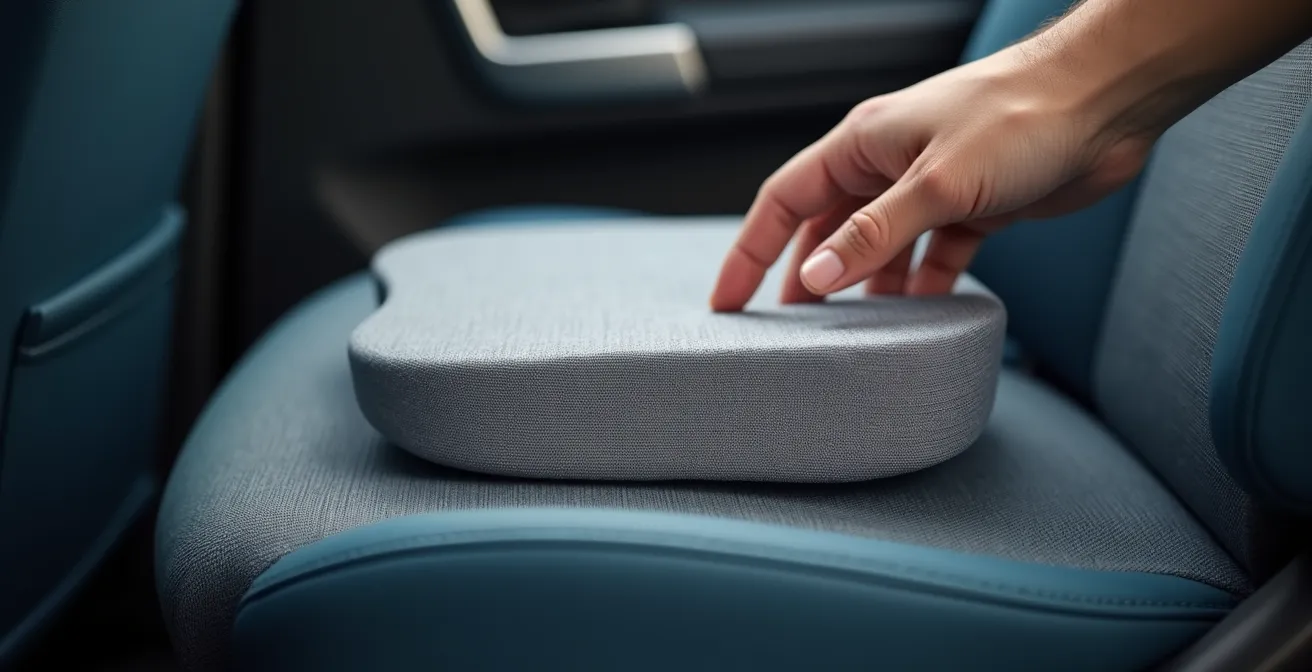
As this visual demonstrates, the material construction of a specialized cushion is designed to respond to pressure and provide targeted relief, a feature standard seats lack. Investing in a quality cushion is a small price for a significant reduction in logistical stress.
Companion Brakes vs. Wheel Locks: Which Is Safer on Ramps?
Brakes are a non-negotiable safety feature, but understanding the different types and their specific functions is critical for a caregiver. The two primary systems on a transport chair are wheel locks and companion brakes. Many caregivers mistakenly believe they are interchangeable, but they serve distinct purposes related to safety mechanics. Wheel locks are static brakes, typically push-to-lock levers located on the main wheels. Their sole function is to prevent the chair from moving when it is stopped, essential during transfers in and out of the chair.
Companion brakes, also known as hand brakes, are located on the push handles for the caregiver to operate. These are dynamic brakes, designed to control speed and provide stopping power while the chair is in motion. On a ramp or incline, this distinction is a matter of safety. Companion brakes allow you to safely modulate your descent, preventing the chair from gaining momentum and running away from you. A model like the Nova Medical Products Lightweight Transport Chair is often highlighted for its patented, locking hand brakes that give the caregiver confident control on inclines.
Never rely on wheel locks to slow a chair down a ramp; they are not designed for it and can cause an abrupt, dangerous stop. The correct procedure is to use companion brakes to manage the descent and only engage the wheel locks once you have reached a flat, stable surface. Mastering both systems is fundamental to preventing accidents and managing the physical forces at play on uneven terrain.
Action Plan: Ramp and Incline Safety Protocol
- Check brake engagement: Before every single transfer, confirm that the wheel locks are fully engaged to prevent unexpected movement.
- Use dynamic control: Always use the companion (hand) brakes to control speed while descending ramps or slopes.
- Engage when static: Once stopped on any incline, however brief, fully engage the wheel locks.
- Test both systems: Before attempting a slope for the first time with a new chair, test both the companion brakes and wheel locks on a flat surface.
- Maintain uphill position: When stopped on an incline, always position your body uphill of the chair to act as a physical backstop.
The Mistake of Expecting the Senior to Propel a Transport Chair
One of the most fundamental—and frequently misunderstood—aspects of a transport chair is its method of propulsion. A standard manual wheelchair has large rear wheels with push-rims, allowing the user to propel themselves. A transport chair, by design, has four small wheels and is incapable of self-propulsion. This is not a flaw; it is its defining feature, but it creates a critical expectation gap if not understood.
The small-wheel design is a deliberate trade-off. It makes the chair significantly lighter and more compact when folded, directly benefiting the caregiver who has to lift and store it. However, it places 100% of the propulsion responsibility on the caregiver. As the experts at VOCIC Medical Equipment state clearly, this is the entire point of the device:
Transport wheelchairs are not self-propelled, in contrast to the usual type of wheelchairs, which are pushed by the caregiver or companion. This renders them suitable for those who are unable to move a wheelchair independently
– VOCIC Medical Equipment, What Is a Transport Chair? – Complete Guide
Expecting a senior to “help out” by pushing the wheels or shuffling their feet is not only ineffective but can also be unsafe, potentially leading to instability or foot injuries. The caregiver must be prepared and physically able to provide all the motive force for the entire duration of the trip. This reinforces the importance of an ultra-lightweight frame discussed earlier; a lighter chair requires less force from the caregiver for every push.

The visual difference is clear: the large-wheel design of a standard wheelchair provides the necessary leverage for self-propulsion, while the small-wheel design of a transport chair prioritizes low weight and compactness for the caregiver. Recognizing this distinction is key to choosing the right tool for the job and avoiding frustration for both the senior and the caregiver.
How to Gate-Check a Transport Chair Without It Getting Damaged?
Air travel introduces a major point of logistical friction for caregivers: getting essential medical equipment to the destination intact. A transport chair’s lightweight, foldable nature makes it an excellent choice for travel, as it’s far easier to manage through an airport and gate-check than a standard wheelchair. As one caregiver noted, its design makes it “so easy to fold up and place in a car trunk or to gate-check when going on an airplane.” However, this convenience comes with the risk of damage during handling by airline staff.
You cannot simply hand over the chair and hope for the best. Proactive preparation is required to protect your investment and ensure it arrives in working order. The goal is to make the chair as compact, secure, and clearly identified as possible. This involves removing all loose parts, securing the frame, and clearly labeling it as essential medical equipment that must be returned to you at the jet bridge, not sent to baggage claim.
Follow this pre-flight checklist to drastically reduce the risk of damage:
- Document its condition: Take time-stamped photos of the chair from multiple angles right at the gate. This provides proof of its pre-flight condition.
- Remove all detachable parts: This includes footrests, cushions, and any side bags. Carry these items on board with you in a separate bag.
- Secure the frame: Once folded, use brightly colored zip ties or bungee cords to keep the chair from unfolding during transit. This also makes it more visible.
- Invest in a travel bag: A padded travel bag designed for wheelchairs is the best defense against scratches, dents, and impacts.
- Label clearly: Attach a laminated card with your name, phone number, and return address directly to the chair’s frame.
- Specify gate-check instructions: When you get the gate-check tag, explicitly request that it be marked for “return to jet bridge.” Reiterate this to the gate agent.
- State its importance: Verbally inform the gate agent: “This is essential medical equipment and is required for mobility upon landing.”
Choosing Between Manual and Power Wheelchairs for Long-Term Shoulder Health
A transport chair is a specialized tool, and understanding where it fits within the broader ecosystem of mobility aids is crucial. For caregivers, the primary alternatives are standard manual wheelchairs and power wheelchairs. The choice between them has significant long-term health implications for both the user and the caregiver. For a senior with some upper body strength, a manual wheelchair offers independence, but over time, the repetitive motion of self-propulsion can lead to severe shoulder strain and injury. A power wheelchair eliminates this strain entirely but introduces immense logistical challenges for the caregiver due to its weight (often 150-300 lbs) and lack of portability.
The transport chair occupies a unique and valuable middle ground. It completely eliminates the risk of shoulder injury for the senior, as self-propulsion is impossible. For the caregiver, it presents a moderate physical effort for pushing, but its exceptionally low weight and high portability make it vastly superior to a power chair for travel and daily errands. The cost is also a significant factor, with transport chairs being the most affordable option.
This table provides a clear comparison of the key trade-offs, highlighting why a transport chair is often the most practical ergonomic choice for frequent, caregiver-assisted outings.
The data in this table, compiled from resources like VOCIC’s comparative analysis, clearly illustrates the ergonomic trade-offs for both user and caregiver across different wheelchair types.
| Feature | Transport Chair | Manual Wheelchair | Power Wheelchair |
|---|---|---|---|
| Weight | 15-30 lbs | 30-40 lbs | 150-300 lbs |
| Self-propulsion | No | Yes | Yes (motorized) |
| Shoulder strain on user | None | High over time | None |
| Caregiver physical effort | Moderate | Low to moderate | Minimal |
| Cost range | $150-$300 | $200-$500 | $800-$5000+ |
| Portability | Excellent | Good | Poor |
Utilizing Respite Care Services Without Guilt or Anxiety
The right equipment is more than just a piece of metal and fabric; it’s an enabler. A lightweight, easy-to-manage transport chair can be the key that unlocks access to essential services like respite care. Many caregivers feel a sense of guilt or anxiety about seeking help, often because the logistical hurdles of getting their loved one to a day center or program feel insurmountable. The thought of a difficult transfer or a struggle with a heavy wheelchair can be enough to deter them from seeking a much-needed break.
This is where caregiver-focused ergonomics has a profound emotional impact. By reducing the physical strain and logistical friction of each trip, the right transport chair lowers the barrier to accessing support. Research from organizations like RESNA has highlighted the development of chairs specifically designed to minimize caregiver strain and musculoskeletal burden during patient transport. When you are not exhausted or in pain from the simple act of transit, you have more emotional and physical energy to engage with support networks.
The confidence that comes from having a reliable, manageable tool cannot be overstated. It transforms the mental calculation from “This is too much trouble” to “This is doable.” As the Caregiver Support Network eloquently puts it, this confidence is a powerful antidote to caregiver burnout.
The confidence that you can safely and easily manage appointments and travel removes a huge layer of logistical stress, freeing up mental and emotional energy that would otherwise be consumed by worry
– Caregiver Support Network, 15 Best Transport Chairs for the Elderly
Investing in a tool that makes your life easier is a form of self-care. It empowers you to utilize services like respite care not as a last resort, but as a regular, healthy part of your caregiving routine, free from guilt and anxiety.
Key Takeaways
- A chair’s weight is a direct investment in your back health. Every pound saved reduces the cumulative load on your body over hundreds of lifts.
- Companion brakes and wheel locks serve different functions. Companion brakes provide control on ramps, while wheel locks ensure static safety during transfers.
- Leverage digital accessibility tools like Google Maps before you leave. Pre-planning routes and entrances eliminates real-world stress and surprises.
Why Google Maps Accessibility Features Are Essential for Trip Planning?
Having the perfect transport chair is only half the battle. The other half is navigating a world that isn’t always built for wheels. Arriving at a doctor’s office only to find a flight of stairs at the entrance is a moment of pure, avoidable stress. This is where digital planning becomes an indispensable part of the caregiver’s toolkit. Leveraging technology like Google Maps is no longer a convenience; it’s an essential strategy for eliminating logistical friction.
Google Maps has a “Wheelchair Accessible” filter that can transform trip planning. When activated, it prioritizes routes that avoid stairs and highlights accessible transit options. This simple digital check can save immense physical and emotional energy on the day of the appointment. You can scout the route from your home, identify potential obstacles, and even use Street View to visually inspect the entrance of your destination for ramps or level entryways. This foreknowledge turns uncertainty into a confident plan.
For even greater detail, this digital reconnaissance can be supplemented with crowd-sourced apps like Wheelmap or AccessNow, which provide user-submitted information on the accessibility of specific venues. Building a pre-trip digital checklist ensures you’ve anticipated as many variables as possible before you even leave the house.
- Activate the ‘Wheelchair Accessible’ filter in your Google Maps settings.
- Review transit or walking routes specifically for marked stairs or steep elevation changes.
- Use Street View to get a real-world look at the destination’s entrance and surrounding area.
- Note the locations of accessible restrooms along your route or near your destination.
- Screenshot or save offline maps of your planned accessible route in case of poor cell service.
By reframing the selection of a transport chair around your own ergonomic needs, you are not being selfish; you are being strategic. You are choosing a tool that will protect your body, conserve your energy, and reduce the stress of every journey. The next logical step is to critically evaluate your current equipment—or your options for a new one—through this practical, weight-conscious lens. This proactive choice is one of the most powerful things you can do to ensure you can continue to provide the best care for years to come.
Frequently Asked Questions About Transport Chair Navigation
Can transport chairs handle curbs and uneven surfaces?
Transport chairs are best used for relatively smooth surfaces like those found on shopping trips, in doctor’s offices, or during travel. Their small wheels make navigating curbs and very uneven ground challenging. For safety, you should always look for designated curb cuts or ramps rather than attempting to bump the chair up or down a curb.
How narrow of a doorway can a transport chair fit through?
Most standard transport chairs have a seat width of 17 to 19 inches, resulting in an overall frame width of around 22-24 inches. This compact size allows them to fit through most standard residential and commercial doorways, which are typically 32 inches wide, with ease. Always check the specific overall width of a model if you know you’ll be navigating particularly narrow spaces.
Are transport chairs suitable for outdoor use?
While transport chairs can be used outdoors, they perform best on paved, smooth surfaces like sidewalks or paths. They are not ideal for rough terrain, grass, or gravel, where their small wheels can get stuck or provide a bumpy ride. For significant outdoor use on varied terrain, a wheelchair with larger rear wheels would offer better stability and maneuverability.